If you searched "can you ship cottage food," here's the short answer: generally, no — not across state lines. The moment a cottage food product crosses a state border, it stops being a state-regulated cottage food and becomes interstate commerce, which falls under federal jurisdiction. Cottage food laws are state exemptions from state licensing rules. They carry no weight once your package leaves the state.
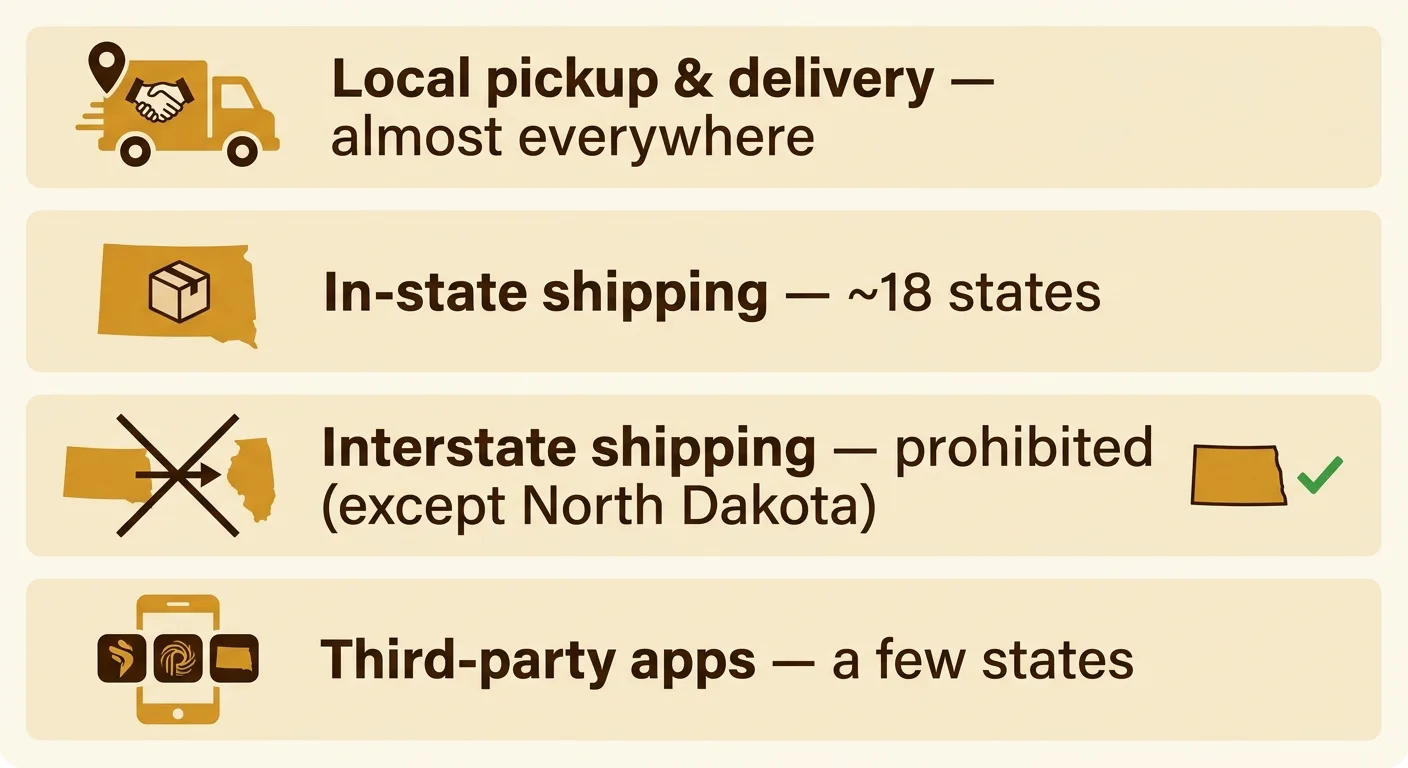
But that is not the whole answer, and most guides stop there. Roughly eighteen states let you ship cottage food within your own state. Almost every state lets you take orders online for pickup or local delivery, even where shipping is off the table. And two states — North Dakota and, starting in 2027, Minnesota — are changing the picture entirely. "Can you ship cottage food," "can you sell cottage food online," and "can you take online orders" are three different questions, and this guide answers each one separately, with the actual state-by-state rules.
The Four Ways to "Sell Online" — And Which Your State Allows
"Selling online" is not one thing. It covers four genuinely different activities, and your state's cottage food law can allow one of them while prohibiting the other three. Conflating them is the single most common mistake home bakers make when they read a cottage food statute and try to figure out what it means for their business.
- Local pickup and in-person delivery. You take an order — by phone, DM, or a storefront — and the customer picks it up from you or you hand-deliver it within your area. This is allowed almost everywhere. It is the baseline every cottage food law is built around: a direct, in-person transaction between you and the person eating the food.
- In-state shipping or mail order. You package the product and send it through a carrier (USPS, UPS, FedEx) to a customer elsewhere in your own state. This is allowed in a minority of states — see the list below.
- Interstate shipping. You ship across a state line. This is almost universally prohibited, because it triggers federal FDA jurisdiction over interstate commerce, which no state cottage food exemption can override. More on why below.
- Third-party delivery apps and vendors. A platform like DoorDash or Uber Eats, or a retail vendor acting as your agent, handles the handoff instead of you. This is a separate, state-conditional bucket with its own rules — covered further down.
The distinction that trips people up most: taking orders online is not the same as shipping. Running a storefront where customers browse your menu, pay, and choose a pickup or local-delivery window is legal in almost every state — including most of the states where mailing a box of cookies to a customer is not. If you've assumed your state bans "online sales" because it bans shipping, it's worth checking again — the rule you're running into is almost always about the fulfillment method, not the ordering method.
Which States Let You Ship Cottage Food In-State
If your state allows in-state shipping, you can package your product and send it by mail or courier to a customer anywhere within your own state — you just can't send it across a state line. Here's how the map actually breaks down.
States that allow in-state shipping or mail order (18)
- Arkansas
- California
- Florida
- Georgia
- Hawaii
- Iowa
- Indiana
- Kansas
- Maryland
- Michigan
- North Carolina
- New Hampshire
- Oregon
- South Carolina
- Tennessee
- Virginia
- Vermont
- West Virginia
If you're in one of these states, you can build a real mail-order side of your business — a customer three counties over can order a jar of jam and have it show up in a box, no pickup required. Each state still layers on its own packaging, labeling, and carrier rules, so check your state's guide before you tape the first box shut.
The one interstate exception: North Dakota
Every other state in this guide treats "interstate" as off-limits. North Dakota is the exception. SB 2386, effective March 2025, amended § 23-09.5-02 to permit North Dakota cottage food producers to ship most products across state lines — poultry products are excepted.
Here's the caveat, and it matters: a state law permitting interstate sales does not remove federal FDA jurisdiction over interstate commerce. North Dakota can tell its own producers they're allowed to ship out of state under state law, but it cannot waive federal authority over food once it crosses a state line. A North Dakota baker shipping cottage food to another state is still operating in a space the FDA has jurisdiction over — state permission is not the same as federal clearance. Treat North Dakota as "the one state that affirmatively allows it, with a federal caveat still attached," not as a fully resolved green light.
Shipping coming soon: Minnesota (August 1, 2027)
Minnesota is not on the in-state shipping list yet — but it will be. A 2025 overhaul of Minnesota's cottage food law legalizes in-state shipping, effective August 1, 2027. Until that date, Minnesota cottage food orders have to be fulfilled in person; there's no mail or carrier shipping of home-produced food in Minnesota today. If you're a Minnesota baker planning around this, mark the date — the rule isn't live yet, no matter what a search result summary might imply.
These lists reflect our state guides, linked above — rules change, so confirm the current rule in your state's guide before you ship anything.
So, Can You Ship Cottage Food Across State Lines? (Almost Always No)
Here's the mechanism behind the blanket "no." The moment cottage food crosses a state line, it becomes interstate commerce, and interstate commerce in food is regulated by the FDA under the Federal Food, Drug, and Cosmetic Act (FD&C Act) and the FDA Food Safety Modernization Act (FSMA). Cottage food laws are state-level exemptions from state licensing and inspection requirements — they don't exist at the federal level and carry no authority once a shipment leaves the state that granted the exemption.
That's the core tension: a product that's completely legal to make and sell from your home kitchen under your state's cottage food law is not automatically legal to ship to a customer in another state. Selling interstate generally puts a producer back under federal requirements — facility registration and the kind of manufacturing standards cottage food exemptions specifically excuse a home kitchen from meeting at the state level. The exemption that makes your kitchen legal at home doesn't travel with the package.
This is why "can you ship cottage food across state lines" has a consistent answer across the country: with one documented exception, no. North Dakota is that exception at the state-law level — and even there, the federal-jurisdiction caveat above still applies. For every other state on this list, interstate shipping of cottage food sits outside what your cottage food exemption protects, regardless of how careful your packaging is or how small the shipment.
If you want to read the federal source material directly, the FDA's food business pages at fda.gov cover interstate jurisdiction over food products in more depth than any state cottage food statute will.
Taking Orders Online When You Can't Ship: The Practical Path
Here's the part most guides skip entirely, and it's the most useful thing in this article if your state isn't on the shipping list above: not being able to ship does not mean you can't run a real online business.
In the large majority of states, you can take orders online, collect payment up front, manage pickup or local-delivery windows, and print a compliant label for every order — all without shipping anything. "Online orders fulfilled locally" and "shipping" are legally distinct, and most states' cottage food laws only restrict the second one.
States where you take online orders + local delivery, no shipping (23)
- Alaska
- Alabama
- Arizona
- Colorado
- Connecticut
- Delaware
- Idaho
- Illinois
- Kentucky
- Massachusetts
- Nebraska
- New Jersey
- New Mexico
- Nevada
- New York
- Oklahoma
- Pennsylvania
- Rhode Island
- South Dakota
- Texas
- Utah
- Wisconsin
- Wyoming
States that lean in-person / pickup-focused (7)
If you're in one of these states, your real opportunity isn't a shipping label — it's a storefront. A MyPorch storefront lets you take online orders, set your own pickup and local-delivery windows, and generate compliant labels for every order, all without touching the shipping question at all. The legal ceiling on shipping doesn't cap what you can build around local orders.
For the mechanics of running that side of the business well, see How to Take Pre-Orders for Your Home Bakery and The Best Order Management Tools for Home Bakers — both cover the workflow once you've decided orders will be local.
Third-Party Delivery Apps and Vendors
There's a fourth bucket most cottage food guides ignore entirely, and it's worth knowing about even if it doesn't apply to you today: third-party delivery platforms and retail vendors.
Some states explicitly permit a cottage food producer to sell through a third-party delivery platform (think DoorDash or Uber Eats) or through a retail vendor acting as the producer's agent — a farm stand, a small shop, a market booth selling on your behalf. These arrangements typically come with conditions: the sale usually has to stay in-state, there may be a requirement for direct producer-to-consumer contact before the sale happens, and "homemade" signage or disclosure at the point of sale is common.
States that allow some third-party delivery or vendor sales (9)
The conditions vary meaningfully state to state — some require you to remain the seller of record even when a platform handles delivery, others require the vendor relationship to be disclosed to the customer. If a third-party channel is part of your plan, read the relevant section of your state's guide before you sign up with a platform, not after.
What Happens If You Ship When You Shouldn't
Shipping outside what your state allows — whether that's mailing within your state without the required registration, or shipping across a state line at all — carries real consequences, and they're worth taking seriously rather than treating as a hypothetical.
At the state level, operating outside your cottage food exemption's terms can mean a cease-and-desist order and the loss of your cottage food exemption itself, which pushes your operation into the licensed, commercial-kitchen category you were exempt from in the first place. At the federal level, shipping across a state line puts you under FDA interstate-commerce jurisdiction, with exposure around misbranding and adulteration standards that a home kitchen operating under a state cottage food exemption was never built to meet.
The safe posture is straightforward even if it isn't exciting: keep your sales and your delivery method inside the rules your state's guide lays out, and treat "can I ship this" as a question with a specific state-by-state answer rather than a guess. If you're not sure where your state lands, the full cottage food law comparison hub is the fastest way to check before you commit to a shipping model. For the underlying legal foundation of selling from home at all, Is It Legal to Sell Baked Goods From Home? is the place to start, and How to Price Your Baked Goods is worth reading once your fulfillment model is settled, since shipping and local pickup carry genuinely different cost structures to price around.
Frequently Asked Questions
The honest version of this answer is three separate answers: interstate shipping is off the table almost everywhere, in-state shipping is a real option in about eighteen states, and taking orders online for pickup or local delivery is legal in nearly all fifty. Know which question you're actually asking before you build around the answer — and confirm the current rule in your state's guide before you tape the first box shut.