
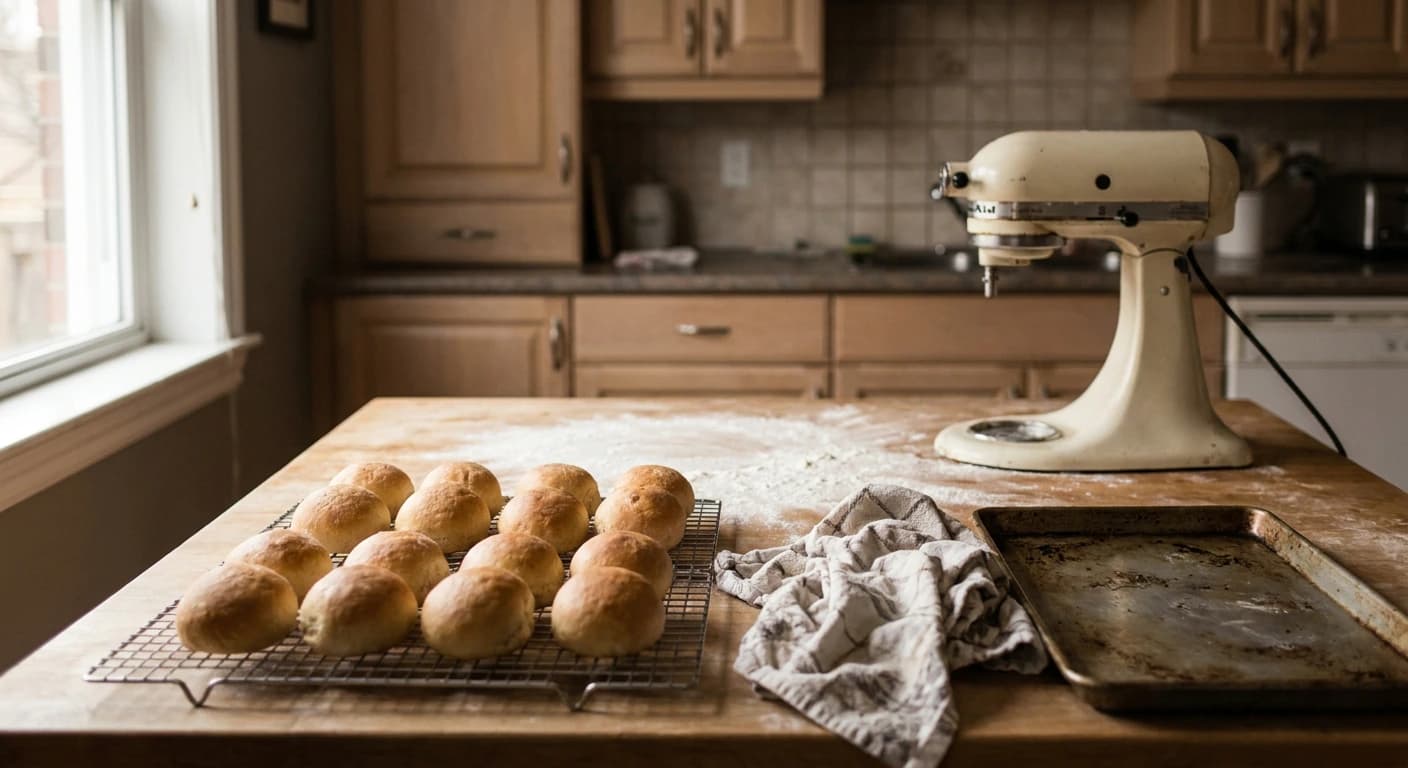
For most home bakers, the answer is no. You almost certainly do not need a commercial kitchen to sell baked goods, because your state's cottage food law exists precisely to let you bake and sell from the kitchen you already have.
It is a reasonable thing to worry about. You start looking into selling a few loaves, you run into phrases like "licensed food facility" and "commissary requirements," and within ten minutes you are picturing a stainless steel rental you cannot possibly afford. Most of the pages you land on are not written for you at all — search "commercial kitchen requirements" and you will mostly find guides for people opening restaurants.
This guide is for home bakers trying to work out whether they can legally stay in their own kitchen. By the end you will know the answer for your situation, the six things that would genuinely force you out, and one trap that most articles on this topic miss entirely.
The short answer: your home kitchen is the point
Cottage food laws are carve-outs. They exist to exempt small home producers from the licensing, plan review, and inspection regime that applies to restaurants and food manufacturers. The exemption is not a loophole you are sneaking through — it is a deliberate policy choice nearly every state has made.
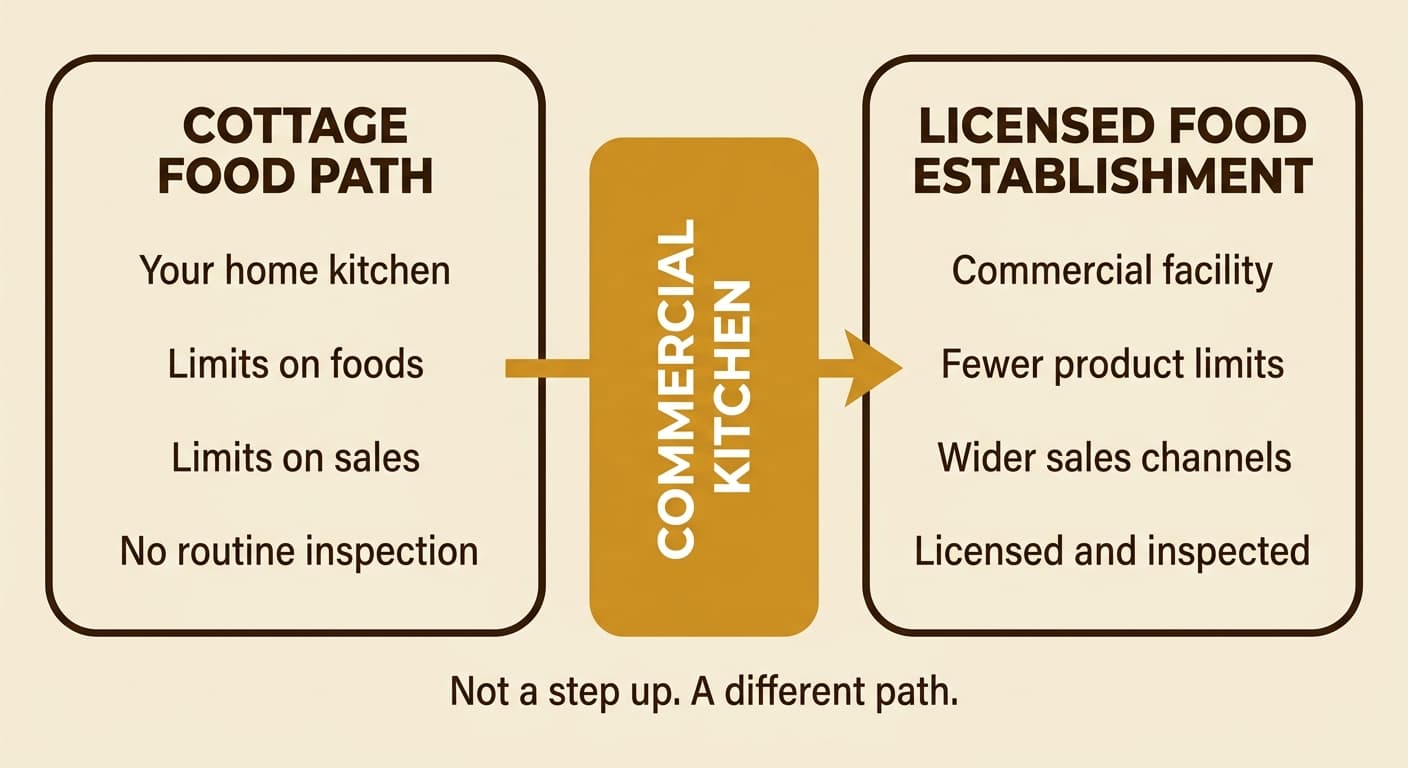
That means there are really two paths, and they are not two rungs on the same ladder.
On the cottage food path, you produce in your primary residence's kitchen. In exchange you accept limits: on what you can make, how much you can sell, and where you can sell it.
On the licensed food establishment path, you produce in a commercial-grade facility that is licensed and inspected. In exchange, most of those limits go away.
Here is the part worth sitting with: moving into a commercial kitchen does not advance you along the first path. It moves you onto the second one, with everything that comes with it. For most home bakers, the sensible goal is to stay on the cottage food path for as long as it genuinely fits the business.
The trap most guides miss: renting a commercial kitchen can end your exemption
This is the part that catches bakers off guard, and it is the opposite of what most people assume.
In several states, renting a commercial kitchen does not upgrade your cottage food operation. It disqualifies you from it. The laws are frequently written around your primary residence, so the moment production moves to an outside facility, the exemption stops applying.
The wording in our state guides is unusually direct on this point:
- Connecticut states that outbuildings, barns, sheds, second homes, and rented commercial kitchens do not qualify for the cottage food license.
- Indiana treats a rented commercial kitchen as flipping you into a licensed food business.
- Iowa indicates a rented commercial or shared kitchen would likely push you into licensed food facility territory rather than cottage food.
- Virginia states that production in a church, community, or commercial kitchen removes the exemption and subjects you to full VDACS licensing and inspection.
- Wyoming notes that a commissary or co-packing kitchen would typically be licensed and inspected, placing your product outside the Food Freedom Act's definitions.
So "I will just rent kitchen time to be safe" is not the cautious choice a lot of bakers assume it is. In these states it is the choice that ends the exemption you were trying to protect.
⚠ Watch out
Check Before You Book Kitchen Time If you are in a state that treats an outside facility as leaving the exemption, booking a few hours at a shared kitchen can end your cottage food status before you have baked anything. Confirm your own state's rule first — this is the one step on this page worth doing before you spend a dollar.
This is not universal, and the contrast is stark. Rhode Island does the exact opposite: its law explicitly lets you produce cottage foods in a licensed commercial kitchen you lease or rent, provided you keep records of the dates you use it — and if you do, the verbatim disclaimer is not required on your labels. Two neighbouring states, opposite answers. That variation is exactly why the next section matters more than any single rule you read online.
What actually forces you out of your home kitchen
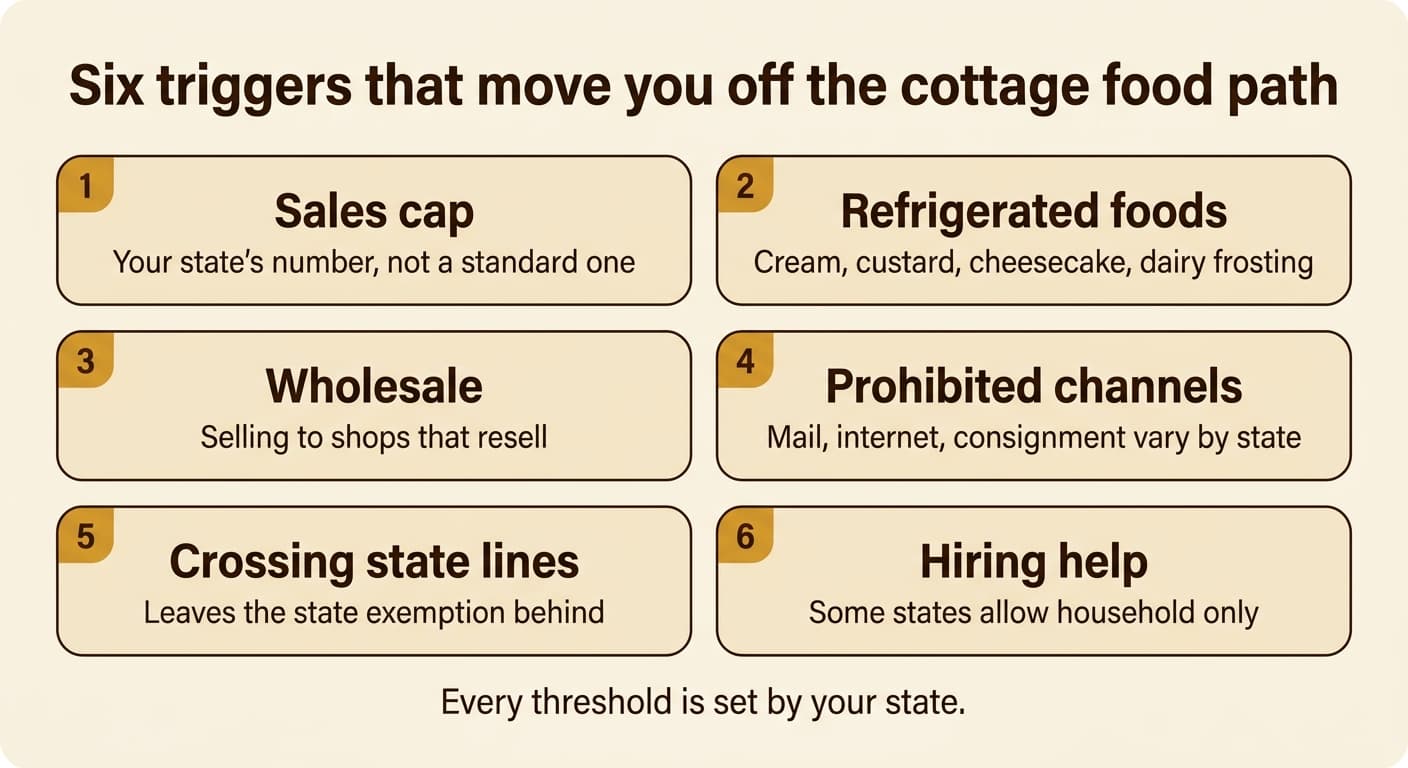
If the home kitchen is the default, what genuinely changes it? In practice it comes down to six triggers. Every one of them is defined by your state, so treat these as categories to check rather than numbers to memorize.
1. Exceeding your state's sales cap
The most common trigger, and the one most bakers hit first if they hit any. Many states cap gross annual sales under the exemption. Cross the line and you generally have two options: stop selling under the exemption for the rest of the calendar year, or move production into a licensed facility.
The caps are not remotely consistent:
| State | Cap that triggers a move |
|---|---|
| Colorado | $10,000 net per individual product |
| New Jersey | $50,000 gross |
| Kentucky | $60,000 |
| Texas | $150,000, adjusted for inflation |
| Alaska | $250,000 gross and 250,000 individual items |
| Ohio | No cap at all |
Maryland, Michigan, Louisiana, Washington, Oregon, and Virginia all run cap-triggered rules of their own. Note what Colorado does differently — its threshold applies per product rather than to your whole business, which is a genuinely different calculation than a single revenue ceiling.
And note Ohio. "No cap" does not mean a cap of zero. It means nothing in the statute forces you into a commercial kitchen on revenue alone, however well the bakery does.
2. Making foods that need refrigeration
The second most common trigger is the kind of food you make. Products that require temperature control for safety — often shortened to TCS, and sometimes still called potentially hazardous foods — are restricted or excluded almost everywhere. Cream fillings, cheesecakes, custards, and dairy-based frostings are the usual culprits for bakers.
In Florida, a product that requires refrigeration or uses TCS ingredients has to be produced in a licensed food facility.
Do not generalize this one. Some states have built supplemental registration pathways that let cottage producers sell certain temperature-controlled items without a commercial kitchen — Texas is the example most often cited. "Refrigerated means commercial kitchen" is true often enough to plan around and wrong often enough that you need to check your own state before you rule a product out.
3. Selling wholesale
Selling to a business that resells your product — a café, a restaurant, a grocery, a gift shop — is a different transaction than selling to the person who eats it, and cottage food frameworks generally do not cover it.
Vermont is explicit that food made under a license exemption cannot be sold to restaurants or other licensed food establishments. Florida draws the same line for wholesale.
This one surprises bakers because it does not feel like a scale problem. You can be tiny and still trip it. A single standing order from one neighborhood coffee shop can be enough.
4. Using a sales channel your state prohibits
Where you sell can matter as much as what you sell. Depending on the state, mail order, internet sales, and consignment arrangements may be restricted or barred outright under the exemption, even when the buyer is in your own state.
5. Shipping across state lines
Cottage food law is a state-level exemption, so carrying product across a state line generally takes you outside the framework that was protecting you. This has its own complications worth understanding properly before you mail anything — we cover them in can you ship cottage food.
6. Hiring help to produce
Several states restrict production under the exemption to the permit holder, sometimes extending to household members. Bringing in outside labor to help bake can trigger reclassification. This varies enough between states that it is worth confirming before you hire anyone, even part-time.
Five mistakes that cost bakers real money
Renting kitchen time "to be safe." In Connecticut, Indiana, Iowa, and Wyoming this is the move that ends the exemption. The cautious-feeling choice is the disqualifying one.
Quoting a cap you read in an article. The $50,000 figure that circulates as the cottage food limit is New Jersey's number. Colorado's is $10,000 and applies per product. Ohio has none. Budgeting against the wrong one either scares you off early or blindsides you mid-year.
Assuming refrigerated always means no. It usually means restricted, not forbidden. Texas registers cottage operators for certain temperature-controlled sales. Ruling out an entire product line on a general rule is how bakers give up a viable business they were allowed to run.
Treating one wholesale order as harmless. A standing order from one café is a wholesale relationship. It does not scale gradually into one — the first delivery is already across the line in states like Vermont and Florida.
Reading a restaurant guide and thinking it applies to you. Most "commercial kitchen requirements" pages are written for people opening restaurants, and a good number are templated boilerplate with a state name dropped in. If a page never mentions cottage food or home kitchens, it is not answering your question.
What actually changes if you do move
If a trigger genuinely applies, it is worth knowing what you are stepping into, because the rent is the part people focus on and rarely the part that bites.
You take on licensing and inspection. A licensed facility operates under the food-establishment rules the exemption was shielding you from: application, approval, and health inspections on the regulator's schedule rather than yours.
You take on someone else's calendar. Shared kitchens are shared. You bake when the room is free, which may not be the night before your pickup window. For a baker whose whole model is Saturday morning handoffs, this is often the bigger adjustment.
You also gain real things. The product limits largely disappear, wholesale opens up, and the sales channels your state restricted stop being a constraint. For a bakery that has genuinely outgrown the exemption, that trade is worth making — the mistake is making it before you have to.
Why you cannot trust a single number you read online
Most articles on this subject state a cap as though it were national. You will see "$50,000" quoted confidently as the cottage food limit. It is not a national number. It is one state's number, repeated until it sounded like a fact.
The honest position is narrower and more useful: the categories of trigger are consistent across states, and almost nothing else is. Cap amounts differ by more than an order of magnitude. Whether refrigerated products are permitted at all differs. Whether a shared kitchen disqualifies you differs. Whether you may hire help differs.
So use the six triggers above as your checklist, and get every actual number from your own state. That is what the state guides are for — one per state, with the official sources cited on each page.
✓ Tip
Write Down Your Four Answers First Before you read your state's rule, write down what you bake, who you sell to, how it reaches them, and roughly what you expect to sell in a year. Those four answers decide every one of the six triggers, and having them ready turns a long statute into a short lookup.
What it costs if you do need one
If you genuinely have crossed into licensed-facility territory, it helps to know the shape of the expense before you start calling around. The figures below are ranges reported by kitchen rental marketplaces rather than audited or official data, so treat them as budgeting orientation, not quotes.
Shared commissary time is commonly reported at $15 to $50 per hour, reaching roughly $75 per hour in expensive metros. Monthly memberships are often quoted around $300 to $600 for part-time access and $700 to $1,200 for full-time, with cold or dry storage frequently adding $50 to $150 per month. Marketplace-style project rentals run higher per hour and vary sharply by city.
One warning worth taking seriously: you will also find "ghost kitchen" or dedicated-station products advertised at $1,500 to $4,000 per month or more. Those are built for delivery-only restaurant brands running daily volume. A weekend baker pricing that tier is looking at the wrong product entirely, and it is an easy way to talk yourself out of a business that was actually viable.
Also worth weighing: the cost is not only rent. Moving to a licensed facility usually brings licensing fees, inspections, and a real amount of scheduling friction, because you are now baking when the kitchen is free rather than when you are.
How to find your rule, not a general one
Three steps, in order:
- Find your state's actual cottage food rules. Start with your state's guide and follow the official sources it cites.
- Run the six triggers against your own plan. What are you baking, who are you selling to, through what channel, and roughly what volume?
- Confirm the edge cases with your regulator before you build around them. If a product sits near the refrigeration line, or you are considering a shared kitchen in a state that may not allow it, a direct answer from your state agency is worth more than any article, including this one.
Two related questions come up constantly alongside this one, and they are genuinely separate: whether you need a cottage food permit or business license, and what that permit actually costs. Neither is the same question as which kitchen you bake in. If you are still working out whether you can sell at all, start with is it legal to sell baked goods from home.
Staying in your kitchen is usually the right answer
If you worked through the six triggers and none of them apply, you have your answer, and it is the good one. You can bake in the kitchen you already have.
What tends to happen next is worth naming, because it catches people who were braced for a regulatory problem and get an operational one instead. The constraint stops being may I bake this and becomes can I keep track of who ordered what. Twenty orders arriving across Instagram DMs, texts, and a comment thread is not a licensing problem. It is a Saturday morning problem, and it arrives long before any sales cap does.
That is the wall most home bakers actually hit — not the commercial kitchen, but the order list. MyPorch exists for that part: a storefront that takes the orders, a bake list that turns them into a plan, and cottage food labels for supported states, so the kitchen you are already allowed to use is the only thing you have to think about.