You hand a neighbor a loaf of sourdough and they stop mid-bite. "You should sell these," they say. You have heard it a dozen times. And every time, the same question follows: Can I actually do that? Is it legal?
The short answer is yes. In all 50 U.S. states, there is a legal pathway to sell home-baked goods directly to the public. You do not need to lease a commercial kitchen. You usually do not need a business entity. You do not need a health department inspection of your home.
The legal framework designed specifically for home bakers already exists. If you have been holding back because you assumed it was all too complicated or too risky, you can let that go. What you need now is to understand the specific rules in your state — because that is where the variation lives.
What Is a Cottage Food Law?
Historically, selling food to the public meant following the same rules as a restaurant: commercial kitchen, grease traps, three-compartment sinks, regular health department inspections. The overhead made it financially impossible for a home baker to sell a dozen cookies legally.
Over the last two decades, states recognized that certain foods — bread, cookies, shelf-stable cakes — are inherently low-risk. They do not harbor the bacteria that cause foodborne illness the way raw meat or dairy does. Cottage food laws were created as a state-level exemption from commercial food licensing, allowing home bakers to produce and sell specific low-risk products from their residential kitchen, up to a revenue cap, through permitted channels.
Because these laws are passed by individual state legislatures, there is no single national rule. The law in Texas is structurally different from the law in New York. But the underlying framework — exemption, product list, revenue cap, sales channels — is consistent across all 50 states.
The Three Things That Vary by State
When you look up your state's cottage food law, you are looking for three specific variables. Everything else flows from these.
1. Allowed Products
Cottage food laws universally cover "non-potentially hazardous foods" — items that are shelf-stable and do not require refrigeration to stay safe.
- Allowed nearly everywhere: Bread, rolls, cookies, muffins, scones, fruit pies, standard cakes, brownies, dry pasta
- Excluded nearly everywhere: Cheesecake, custard pies, anything with cream cheese frosting, meat-filled pastries, fresh fruit toppings
Some states draw the line more conservatively than others — excluding certain dairy-containing items even if the finished product is shelf-stable. Before you finalize your menu, read your state's allowed product list specifically. When in doubt, leave the item off until you confirm.
2. Revenue Caps
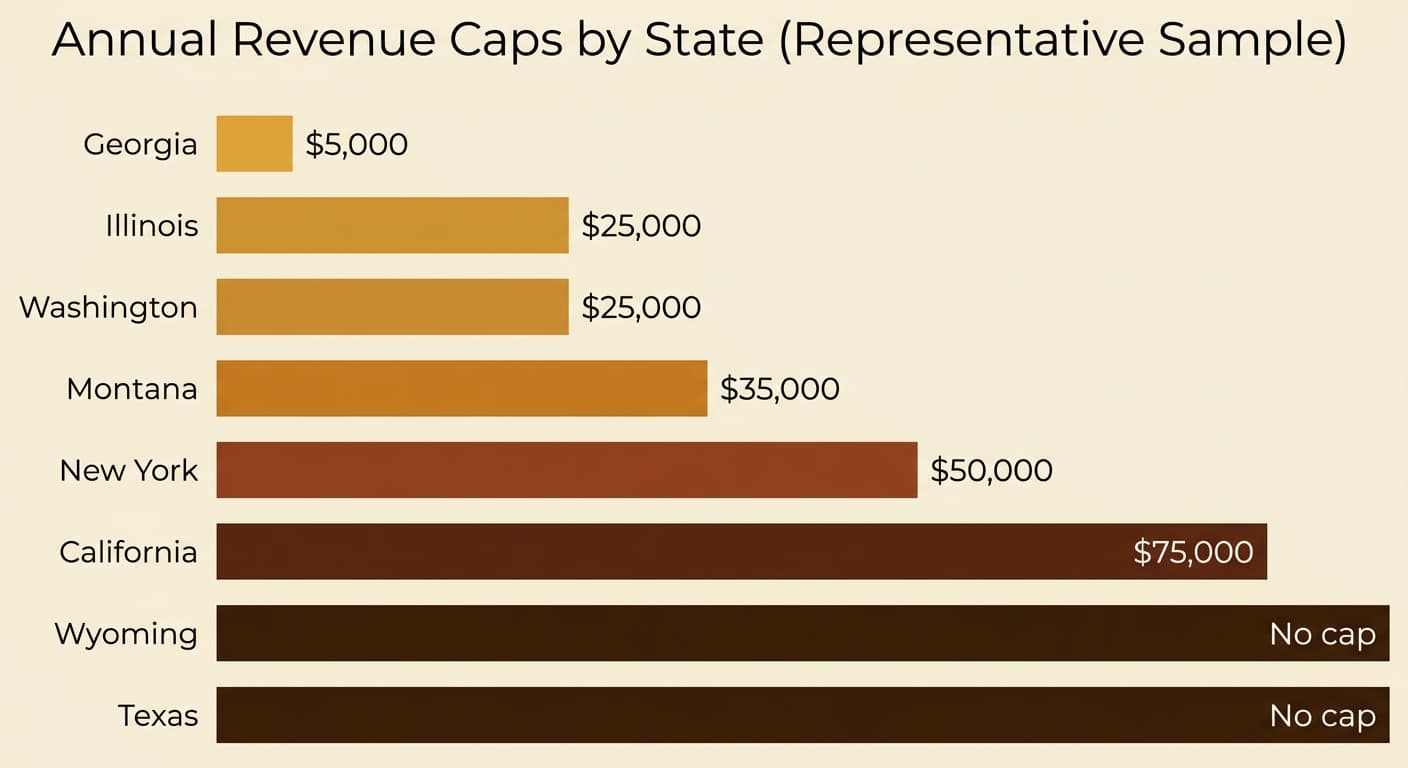
States set an annual gross revenue ceiling for cottage food operations. Below it, you operate under the exemption. Above it, you are expected to transition to commercial licensing.
- Strict states cap sales at $5,000–$15,000 per year — manageable for a side operation, constraining for a primary income
- Most states cluster between $25,000 and $75,000 per year — workable for a serious weekly porch-pickup operation
- The most permissive states — Texas, Wyoming, and a handful of others — have eliminated caps entirely or set them high enough to support full-time income
The cap applies to gross revenue, not profit. Know your state's number before you scale.
3. Sales Channels
This is the variable that affects porch-pickup bakers most directly and the one most commonly misunderstood. States fall into three tiers based on where the food can legally change hands:
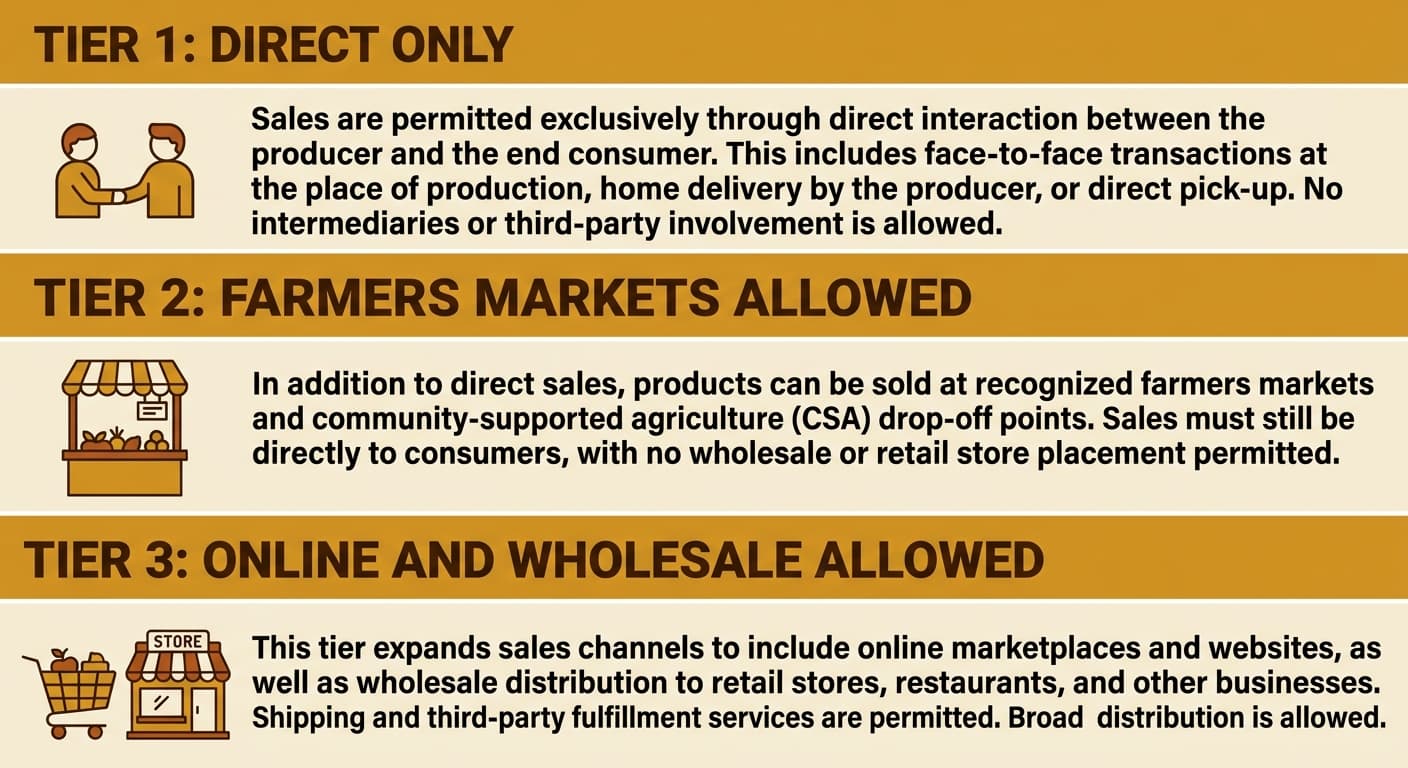
Tier 1 — Direct to consumer only. The transaction and handoff must occur in person, face to face. You can sell from your porch, at a bake sale, or at a community event where you are personally present. (If you are running [the batch order model](/blog/batch-order-model-home-bakery) out of your home, this is almost always classified as a legal direct-to-consumer porch pickup.) What Tier 1 typically excludes is internet sales — a checkout button on your website where the customer never meets you before payment may take you outside the exemption.
Tier 2 — Farmers markets and events permitted. Sales through farmers markets, fairs, and community events are explicitly allowed alongside direct home sales. Some Tier 2 states extend to farm stands and on-farm sales. Internet sales are still typically restricted.
Tier 3 — Most permissive. Online sales, wholesale to retail stores, and in some cases third-party delivery are explicitly permitted. A growing number of states have expanded to this tier in recent years.
“The most common legal mistake porch-pickup bakers make is assuming "direct to consumer" covers internet orders. Read your state's definition of direct sales carefully before you put a buy button on your website.”
What You Do Not Need
In most states, to operate legally under a cottage food exemption, you do not need:
A commercial kitchen. This is the most persistent myth. Cottage food laws exist specifically to remove this requirement for home-based producers. Your home oven and countertop are your permitted production facility.
A health department inspection of your home. In almost all states, the health department is explicitly barred from inspecting your home kitchen unless they receive a direct complaint about a foodborne illness.
An LLC or other business entity. There is no legal requirement to form one before selling under cottage food. Sole proprietorship is sufficient. A DBA ("doing business as") registration — typically $10–$50 at your county clerk's office — is all you need to operate under a bakery name rather than your own.
A commercial food service license. That is the thing the cottage food exemption replaces. A small number of states require a cottage food permit or registration (different from a commercial license, and often free), but most require nothing beyond compliance with the law itself.
What You Do Need (Everywhere)
A basic food safety course. Many states require a brief online food handler's course before you can operate — typically two hours and around $15. ServSafe and similar programs offer these. Even in states where it is not required, it is worth doing.
To sell only allowed products. Know your state's approved list and stay on it. Selling a product that requires refrigeration under a cottage food exemption is a violation in every state.
To stay within your revenue cap. Track gross sales from day one. The cap applies to everything you collect, before expenses.
Proper labeling. This is the one universal requirement across all 50 states, and the one most bakers underestimate. Every item you sell must carry a label identifying it as produced in a home kitchen not subject to state inspection. The full required elements — product name, your address, ingredients, allergens, and the state-mandated disclaimer language — are covered in detail in the cottage food labeling requirements guide. Read it before you sell your first item. A label violation is the most common way cottage food bakers inadvertently step outside the law.
How to Find Your State's Law
Do not rely on a static summary — cottage food laws are amended regularly as state legislatures update caps and expand product lists. Any fixed table goes stale. Get the current answer from the source.
Forrager (forrager.com) maintains the most accurate and frequently updated state-by-state cottage food database available. Start there.
When you read your state's law, look for four things: 1. The revenue cap — what is your annual ceiling? 2. The approved product list — is your specific product (a particular type of frosting, a filled pastry) explicitly allowed? 3. The permitted sales channels — how does the law define "direct to consumer," and does that definition include or exclude internet sales? 4. The labeling requirements — what exact language must appear on your packaging?
When the law is ambiguous, your state's department of agriculture is the right entity to ask. A simple email asking "does your cottage food exemption permit online sales with local pickup?" typically gets a clear written answer within a few days — and gives you documentation if you ever need it.
Common Misconceptions
"I need a licensed commercial kitchen." Not under cottage food. The exemption exists specifically to remove this requirement. Your home kitchen is your permitted production facility as long as you stay within the law's boundaries.
"I need to form an LLC before I can sell anything." No. Sole proprietorship is legally sufficient. An LLC may make sense later for liability protection, but it is not a prerequisite for selling under cottage food.
"'Direct to consumer' means I can sell online." Not necessarily — and often not. Many Tier 1 states define direct sales as an in-person transaction. Selling through your website to someone who later picks up may or may not qualify depending on your state's language. Read the definition before you launch a checkout.
"There is no limit on how much I can earn." Most states have a revenue cap. Know yours. Exceeding it does not necessarily mean you have to stop — it means you may need to apply for a different license tier to continue legally.
"Anything shelf-stable is fine to sell." Not universally. Some states maintain product lists more conservative than "non-refrigerated equals allowed." Confirm your specific products against your state's list before building your menu around them.
What Comes Next
You will likely find the legal question resolves faster than expected. The law has a clear answer, your products likely qualify, and the requirements are finite.
The questions that follow are operational:
- How do you take orders without losing track of them? The pre-order system guide covers the full workflow from order window to bake day labels.
- How do you price so the business actually makes money? The home bakery pricing formula walks through ingredients, packaging, labor, and margin in one calculation.
- What goes on the label? The cottage food labeling requirements guide covers every required element and a label checklist you can use for each batch.
- How do you structure production so you are not guessing what to bake? The batch order model eliminates speculative waste by taking all orders before you mix a gram of flour.
The legal framework is the foundation. Everything else is the system you build on top of it. MyPorch is built specifically for porch-pickup bakers who are ready to move from legal clarity to their first order — menu, cutoffs, payments, and bake list in one place.
Start your free MyPorch storefront →