
You are standing in your kitchen, staring at a 50-pound bag of flour, trying to figure out what to type into your Instagram caption. You need to announce your weekend menu, but you are stuck on the hardest part of running a home bakery: the price tag.
So you do what most home bakers do. You look at what the bakery down the street charges, shave a few dollars off so you don't seem greedy, and post the menu. You sell out in an hour. You feel great. Then you look at your bank account and realize you barely made enough to cover your next grocery run.
The problem is not the baking. It is that you spent your Friday night in flour and your Saturday morning at the door, and afterward made less per hour than you would have stocking shelves. Knowing how to price baked goods correctly is what separates a sustainable cottage food business from one that works hard and breaks even. Most home bakers are undercharging by 30–50% and do not know it because the math is hidden inside habits and guilt.
This guide walks through the four-part pricing formula for cottage food bakers, why it works differently in a pre-order batch model than anything else you will read, and how to work with the guilt discount instead of silently absorbing it.
Why Every Pricing Guide You've Read Was Written for the Wrong Baker
Most baking pricing content is built for one of two situations:
- Custom-order pricing — written for the bespoke cake artist quoting a $400 tiered wedding cake based on custom design hours and one-off ingredient sourcing.
- Farmers market pricing — written for vendors who bake speculatively and adjust prices by end of day to avoid carrying goods home.
If you are running a porch pickup or a weekly bread drop, you are working in a batch pre-order model. You set the price before the window opens. You bake exactly what sold. There is no unsold inventory risk — which is why the batch model is so profitable — but there is a minimum number of orders you need before firing up the oven.
That minimum viable batch number is the variable no generic pricing guide ever addresses. It is also the one that determines whether a Saturday bake day actually works.
The Four-Part Formula for Pricing Baked Goods
The formula has four components. Every number not accounted for here is money you are absorbing without knowing it.
1. Ingredients
Your actual, per-unit raw material cost — based on what you paid, not what you estimate. Look at the receipt.
A standard sourdough loaf (800g) uses approximately $1.80–$2.20 in flour, water, salt, and starter maintenance. If you buy King Arthur in 5-lb bags from the grocery store, your flour cost per loaf is higher than if you buy 50-lb bags from a restaurant supply. Use your real number.
One thing most bakers miss: your starter is not free. The flour you feed it comes from somewhere. Amortize it.
2. Packaging
Packaging is the silent margin-killer. For a sourdough loaf: a heavy-duty kraft bag ($0.18–$0.30), a printed or hand-applied label ($0.08–$0.15), and a twist tie or seal ($0.03). That is $0.40–$0.80 per unit before you have sold a single loaf.
The number compounds across a batch and compounds again if you are not tracking it. For cookies, add a box or bag plus tissue. For cinnamon rolls, a container. Every package has a cost.
3. Labor
This is where most home bakers lose their entire margin.
The question is not "how long did I spend baking today?" It is "how long did I spend on this specific product, per unit?"
For 20 sourdough loaves: mixing the night before, morning shape, scoring and loading, monitoring, and bagging for pickup adds up to roughly 7–8 minutes of active time per loaf. At $20/hour — a standard baseline for skilled food production — that is $2.33–$2.67 per loaf.
Minimum wage is not the right rate for artisan baking. $0/hour, which is what most bakers implicitly set, means you are donating your Friday night.
“Most home bakers set their labor rate at zero. That is not a pricing strategy — it is a donation schedule.”
4. Margin
Margin is not what you pay yourself — that is labor. Margin is what stays in the business: equipment depreciation, failed batches, recipe development, the two Dutch ovens you burned through. A healthy cottage food business needs 20–30% on top of total cost.
The Worked Example
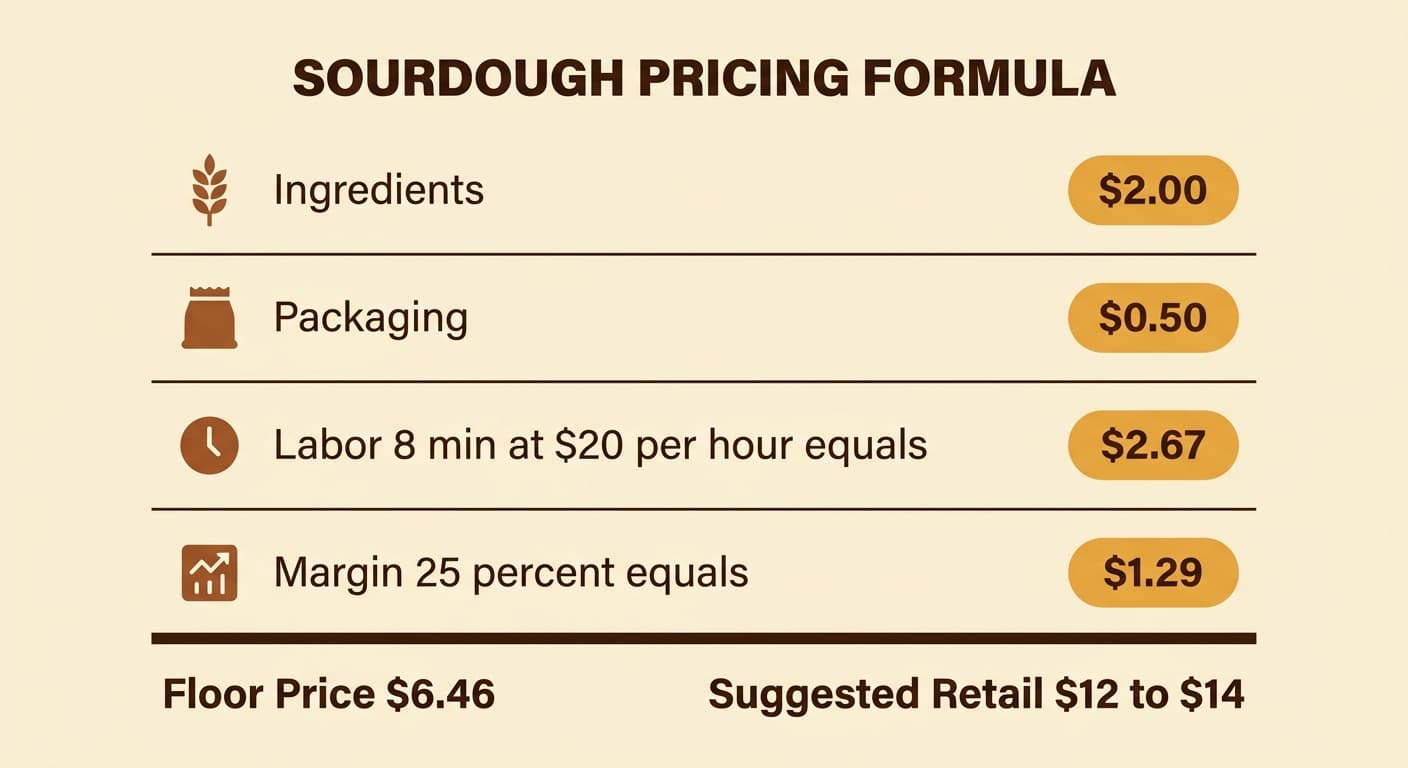
| Component | Cost |
|---|---|
| Ingredients | $2.00 |
| Packaging | $0.50 |
| Labor (8 min at $20/hr) | $2.67 |
| Total cost | $5.17 |
| 25% margin | $1.29 |
| Floor price | $6.46 |
At $6.46 as your floor, a retail price of $12–$14 is entirely defensible. You are not gouging anyone — you are covering your costs and building something sustainable. If that number feels high, the problem is not the formula. It is that you have been running below cost for a while and it has started to feel normal.
The Pre-Order Layer: Minimum Viable Batch
If you are running a batch pre-order model, the formula above gives you your per-unit floor. But there is a second question you need to answer before you open the window: how many orders does this batch need to fill for the bake day to be worth your time?
This is the Minimum Viable Batch.
Here is how to calculate it:
- Decide your target take-home for the bake day. Example: $200 net.
- Calculate your net per unit: retail price minus hard costs (ingredients + packaging). At $13 retail with $2.50 in hard costs, your net is $10.50 per loaf.
- Divide: $200 ÷ $10.50 = 19 loaves minimum.
If your order window closes with 8 loaves, you have a real decision. Baking 8 loaves still requires you to clean the kitchen, preheat the oven, and wait through bulk fermentation. The overhead time doesn't shrink. If you bake those 8 loaves at $13 each, you made $104 for your entire night — not $200.
If you don't hit your minimum viable batch, you don't fire up the oven.
That framing only works if you have a system that tells you where your batch count stands before you start mixing. When you track orders through DMs and texts, you find out how many you sold after you have already baked. A pre-order system with a hard cutoff tells you the number before you turn the oven on — which is the only version of this that protects your time.
The Price-Confidence Gap
The formula gives you the number. The harder problem is sending it to the neighbor who recommended you to three of your best customers, or posting it in the Facebook group where people remember when you were charging $8.
Most bakers manage this discomfort the same way: they drop the price. Not as a business decision — just quietly, in the moment, because the alternative feels uncomfortable. This is the guilt discount, and it is not a pricing strategy. It is an anxiety response that compounds over time into a business that works hard and stays thin.
“The formula gives you the number. The harder work is believing you're worth it.”
Three things that are actually true:
Your regulars are not there because you are cheap. They are there because your bread is good and your Saturday pickup has become part of their week. A $2–$3 price increase does not end that relationship. It might end things with the small number of people who were only there because you were cheap — and those are not your people.
Showing your work disarms the guilt. "Prices are going up in May to reflect current flour and butter costs" lands differently than a silent change. You do not owe anyone a line-item breakdown. One sentence is enough. Most customers respect it immediately.
The bakers charging $8 for sourdough are not your competition. They are running a different thing — a hobby subsidized by unpaid labor. If you are building a real business, you are not competing with someone who is not tracking their costs.
What to Charge: Real Ranges by Product
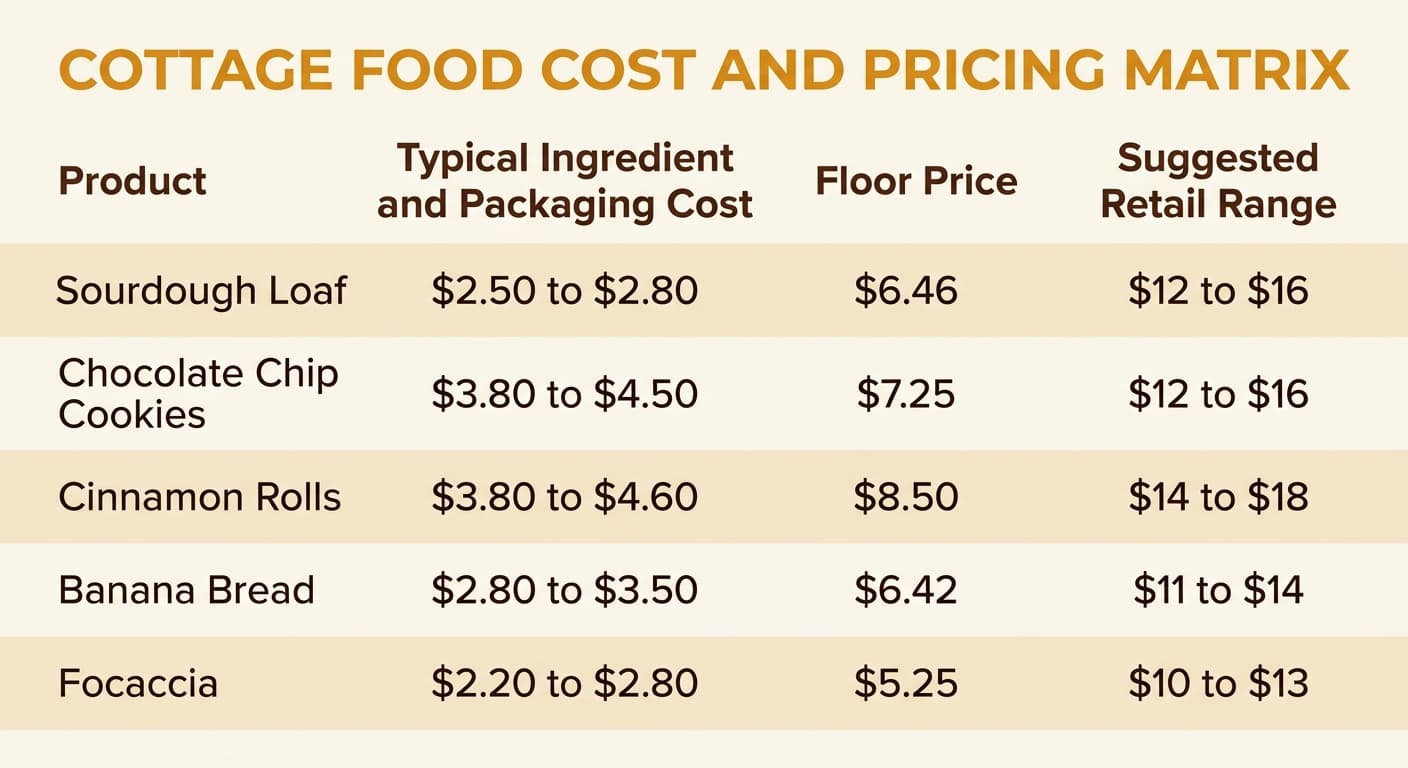
These are worked examples based on current typical ingredient costs and a normal bake day. Your numbers will vary — use these to build your own sheet, not as a price list.
| Product | Ingredient + Packaging Cost | Labor | Floor Price | Suggested Range | Notes |
|---|---|---|---|---|---|
| Sourdough loaf (800g) | $2.50–$2.80 | $2.67 | $6.46 | $12–$16 | High fermentation time; floor rises with premium flour |
| Chocolate chip cookies (dozen) | $3.80–$4.50 | $2.00 | $7.25 | $12–$16 | Swings with chocolate quality; premium inclusions push higher |
| Cinnamon rolls (4-pack) | $3.80–$4.60 | $3.00 | $8.50 | $14–$18 | High perceived value; cream cheese frosting adds cost |
| Banana bread loaf | $2.80–$3.50 | $2.33 | $6.42 | $11–$14 | Low active labor; easy to batch efficiently |
| Focaccia (half sheet) | $2.20–$2.80 | $2.00 | $5.25 | $10–$13 | Fast labor; olive oil and toppings vary cost significantly |
Common Pricing Mistakes
Setting labor at $0 or minimum wage. Your time is skilled artisan food production. The legal minimum for unskilled labor is not the right benchmark. Set a real rate and hold it.
Pricing by what feels right. "Feels right" anchors to what you have seen others charge or what you think the market will accept — neither of which is based on your costs. The formula gives you a floor. Start there.
Guilt-discounting for regulars. You can give a longtime regular a free cookie now and then. That is generosity — a deliberate decision. Permanently lowering your base price out of discomfort is not generosity; it is an anxiety response with a cost you are not measuring.
Not adjusting for ingredient price swings. Flour, butter, and eggs can swing 15–25% year over year. A price you set in September may be underwater by March. Review your formula every quarter. When a key ingredient moves more than 10%, reprice.
Pricing the item without checking the batch. A $13 loaf is fine. A $13 loaf in a batch that only fills to 8 orders when you need 19 is not. Price the unit and verify the batch economics every time you set up a window.
The "I'll raise it later" deferral. Most bakers who say this don't. The discomfort doesn't decrease with scale — it usually increases because you have more to lose. The right time to charge the real price is now.
From Pricing to Orders
The formula gives you confidence in the number. A pre-order system gives you proof the batch filled before you bake.
When your price is right and your order window has a hard close condition, the Saturday bake day becomes logistics instead of guesswork. You know how many loaves to mix Thursday night. You know when to stop taking orders. You know whether the batch is viable before the oven turns on.
That combination — clear pricing, structured pre-orders, bake only what sold — is what separates a cottage food business that is sustainable from one that works hard and stays frustrated.
If you are managing orders through DMs and texts, the pre-order guide covers how to set up a window that closes itself, a bake list that comes from the orders, and a pickup system that does not require you to be at the door for three hours. The batch order model post goes deeper on why baking to confirmed orders reduces waste and protects margins.
Your labeling requirements also connect here: a label with incorrect ingredients is a compliance problem, and a recipe you repriced without updating your label is a liability. Keeping the two workflows in sync matters.
Once you have your pricing locked, setting up a pre-order storefront on MyPorch takes about fifteen minutes. You set the price, build the batch menu, and your order window opens and closes automatically. You bake what sold.
Start your free MyPorch storefront →