Where You Can Sell
- Permitted sales channel: Home Pickup
- Permitted sales channel: Farmers Markets
- Permitted sales channel: Online Orders
- Permitted sales channel: Roadside stands
- Permitted sales channel: Wholesale
- Not permitted sales channel: Interstate Sales
If you are a home baker running a weekly Saturday porch pickup in Texas, you are operating in one of the most baker-friendly states in the country. The Lone Star State recently expanded its cottage food law through SB 541, which took effect on September 1, 2025 and raised the sales cap to $150,000 per year while also opening new paths for TCS foods, wholesale to registered cottage food vendors, and address-privacy registration.
But baking a beautiful loaf and selling it legally are two different things. Texas still offers enormous freedom for many direct-to-consumer bakers, but the post-SB 541 rules are no longer as simple as "no permit, no inspection, shelf-stable only." The state is now more flexible on food types, but stricter about which situations trigger DSHS registration, what online delivery is allowed, and what must appear on your labels.
The sections below focus on the parts of the 2026 Texas Cottage Food Law that matter most when you are deciding what you can sell, when registration is required, and what has to appear on your labels.
Is Cottage Food Legal in Texas?
Cottage food production is fully legal in Texas. Texas Health and Safety Code Chapter 437 governs cottage food operations, and Senate Bill 541, effective September 1, 2025, significantly expanded what Texas home bakers can do.
For many standard direct-to-consumer operators, Texas still does not require a permit, license, or routine inspection before you begin selling. But that no-permit rule is no longer the whole story. Current DSHS guidance says registration is required if you:
- sell time and temperature control for safety (TCS) foods,
- want to use a DSHS registration number on your label instead of printing your home address, or
- operate as a cottage food vendor buying eligible products at wholesale from a cottage food production operation.
The two things every Texas baker needs to know immediately: every product still needs the required disclaimer statement on its label, and your sales model matters more now than it did before SB 541.
Next step
Start taking prepaid orders with Texas-compliant labels
MyPorch helps Texas bakers collect prepaid orders, generate Texas-compliant labels, and keep weekly pickups and customer details organized.
Start your Texas storefrontWhat Foods Can You Sell?
This is one of the biggest places where older Texas guides drifted. Texas is no longer just a classic "shelf-stable only" state.
Texas's cottage food law defines eligible products as foods produced in a private residence that do not fall within the statute's prohibited categories — foods that do not require time or temperature control for safety remain the simplest and most common path, though registered operators may now also produce certain TCS foods under additional rules.
Current DSHS guidance says a cottage food production operation may produce any food except:
- meat, meat products, poultry, or poultry products
- seafood, fish, shellfish, or seafood products
- ice or ice products, including ice cream, frozen custard, popsicles, and gelato
- low-acid canned goods
- products containing cannabidiol (CBD) or tetrahydrocannabinol (THC)
- raw milk and raw milk products
That means standard baked goods are still fine, but Texas also now allows some foods that require time and temperature control for safety as long as the operator follows the newer registration, labeling, and temperature-control rules.
✅ You Can Sell
- Breads, rolls, tortillas, cookies, brownies, cakes, muffins, pastries, and pie
- Candy, fudge, chocolate bark, granola, trail mix, cereals, roasted nuts
- Jams, jellies, preserves, dry mixes, honey, roasted coffee, and dry tea
- Freeze-dried shelf-stable foods
- Approved pickled, fermented, and plant-based acidified products
- Some TCS foods, if you register with DSHS and follow the extra rules
❌ You Cannot Sell
- Meat, meat products, poultry, or poultry products
- Seafood, fish, shellfish, or seafood products
- Ice products, including ice cream, frozen custard, and popsicles
- Low-acid canned goods
- CBD / THC products
- Raw milk and raw milk products
| ✅ You Can Sell | ❌ You Cannot Sell |
|---|---|
| Breads, rolls, tortillas, cookies, brownies, cakes, muffins, pastries, and pie | Meat, meat products, poultry, or poultry products |
| Candy, fudge, chocolate bark, granola, trail mix, cereals, roasted nuts | Seafood, fish, shellfish, or seafood products |
| Jams, jellies, preserves, dry mixes, honey, roasted coffee, and dry tea | Ice products, including ice cream, frozen custard, and popsicles |
| Freeze-dried shelf-stable foods | Low-acid canned goods |
| Approved pickled, fermented, and plant-based acidified products | CBD / THC products |
| Some TCS foods, if you register with DSHS and follow the extra rules | Raw milk and raw milk products |
In Texas, cottage food producers may sell breads, cookies, cakes, candy, granola, jams, jellies, honey, and freeze-dried shelf-stable foods, but not meat, poultry, seafood, ice products, low-acid canned goods, CBD or THC products, or raw milk products.
✓ Tip
If your business model does not need refrigerated or hot-held food, the easiest compliance path in Texas is still to stay with classic shelf-stable products. SB 541 added more flexibility, but it also added more moving parts.
ℹ Note
If you want to sell pickled fruit or vegetables, fermented vegetable products, or plant-based acidified canned goods, DSHS points operators to approved recipe sources and a Request for Official Determination form when using a new recipe source.
In summary, Texas cottage food producers may sell most foods produced in a private residence — excluding meat, poultry, seafood, ice products, low-acid canned goods, CBD/THC products, and raw milk products — with TCS foods permitted only for operators who register with DSHS and follow extra labeling and temperature rules.
Annual Sales Limit
Texas currently sets the annual sales limit for cottage food producers at $150,000 in gross revenue per calendar year. SB 541 raised the cap from $50,000, and the statute now directs DSHS to make annual inflation adjustments using CPI-U.
The $150,000 limit applies to total gross sales — the full amount customers pay you, before deducting ingredient costs, packaging, or any other expenses. Once you exceed this threshold in a calendar year, you are required to transition to a licensed commercial kitchen operation. Most home bakers operating a weekly batch model will not come close to this limit — a baker running one bake day per week at full capacity typically generates $10,000–$30,000 annually.
If you are approaching the cap, that is a strong signal to evaluate whether a commercial kitchen license — and the expanded production and distribution rights it brings — makes sense for your operation.
In summary, Texas cottage food producers may earn up to $150,000 in gross annual sales, with the cap adjusted for inflation going forward, and must transition to a licensed commercial kitchen once that threshold is exceeded.
Sales Channels: Where You Can Sell
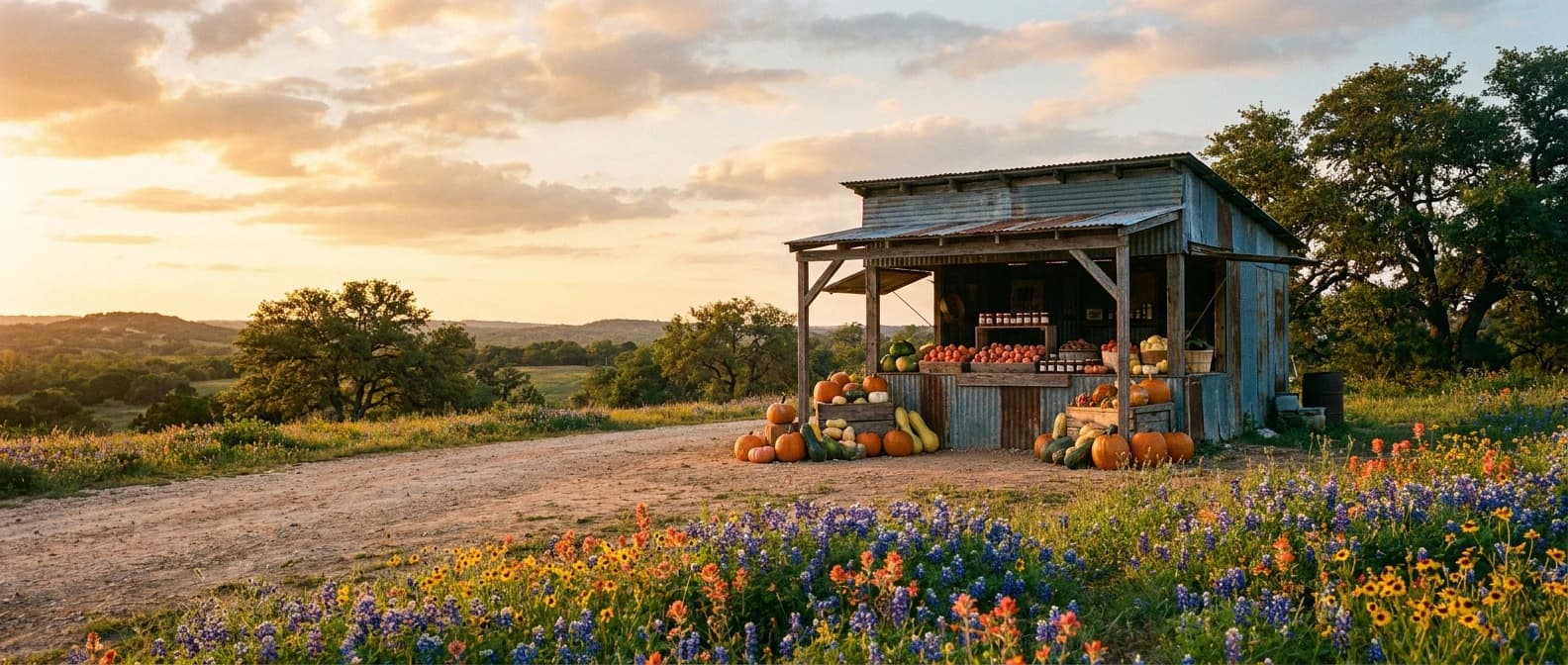
Texas cottage food producers may still sell directly to consumers through familiar channels like:
- Porch pickup and home sales
- Farmers markets
- Roadside stands
- Other direct handoff locations designated by the customer
Online sales are allowed, but the current statute is narrower than many people assume. A consumer may buy through your website only if:
- the consumer purchases the food from you online, and
- you, your employee, or a household member personally deliver the food to the consumer in Texas.
That means Texas is not a general mail-order or carrier-shipping cottage food state.
SB 541 also added a limited wholesale path. A cottage food production operation may now sell eligible non-TCS foods at wholesale to a registered Texas cottage food vendor. That vendor may then sell directly to consumers at a farmers market, farm stand, food service establishment, or retail store.
⚠ Watch out
"Wholesale is allowed in Texas now" is only partly true. The current law does not open general wholesale to every store or restaurant. It creates a narrower lane for registered cottage food vendors, and TCS foods are not eligible for that wholesale path.
In summary, Texas cottage food producers may sell directly to consumers at home, farmers markets, roadside stands, and through personal in-state delivery, with online sales also allowed when the operator or household member personally delivers the product in Texas.
Permit, License, and Training Requirements
For many standard direct-to-consumer bakers, Texas still does not require a permit, license, fee, or pre-opening inspection to begin selling.
But current DSHS guidance says registration is required for:
- cottage food operators selling TCS foods
- operators who want to use a unique DSHS registration number on the label instead of printing a home address
- cottage food vendors that buy eligible cottage foods at wholesale and resell them directly to consumers
DSHS's registration guide describes this as an automatic system approval rather than a hand-reviewed application.
Food handler's certificate is required. While no permit is needed, Texas law requires cottage food producers to hold a valid food handler's certificate from an accredited program. The most common option is a ServSafe Food Handler certificate, which costs approximately $15 and can be completed online in a few hours. Accredited programs are listed on the Texas Department of State Health Services website.
Local jurisdiction note: Texas cottage food law still strongly preempts local ordinances. Local governments may not require a cottage food operation to obtain a local permit or pay a fee to produce or sell directly to a consumer or cottage food vendor. That said, DSHS and local authorities still retain emergency authority when there is an immediate and serious threat to human life or health.
In summary, Texas cottage food producers do not need a permit for standard direct-to-consumer sales, but must hold a valid food handler's certificate and must register with DSHS if selling TCS foods or using a DSHS identification number on the label instead of a home address.
Label Requirements for Texas Cottage Food
Every Texas cottage food product must be labeled before it leaves your kitchen. The label is both a legal requirement and your customer's right to know what they are buying.
Required label elements under current DSHS cottage-food guidance:
- The name of the cottage food production operation
- The address of the cottage food production operation, or a DSHS unique identification number if you registered for that option
- The common or usual name of the product
- Allergen disclosure when a major allergen is present
- The required disclaimer statement (exact wording — see below)
- A unique batch number for pickled fruit or vegetables, fermented vegetable products, or plant-based acidified canned goods
Texas DSHS also maintains a broader food-labeling page for packaged foods that covers ingredient statements, manufacturer name/address, and net quantity rules. For cottage food operators, the safest path is to satisfy both the cottage-food-specific disclosure rules and standard packaged-food labeling expectations.
The required disclaimer — quote this verbatim on every label:
THIS PRODUCT WAS PRODUCED IN A PRIVATE RESIDENCE THAT IS NOT SUBJECT TO GOVERNMENTAL LICENSING OR INSPECTION.
This exact language is required by statute. Do not paraphrase it. Do not abbreviate it. The statement must appear on every product label for every sale.
Extra rules for TCS foods and vendor sales: If you sell a TCS food, the label must include the date the food was made, and the food label, invoice, or receipt must include the DSHS safe-handling statement. If a registered cottage food vendor sells your product, the label must also include the date the food was made.
REQUIRED vs. RECOMMENDED
| Element | Required by current TX guidance | Recommended Best Practice |
|---|---|---|
| Operation name | ✅ Required | Match your public business name consistently |
| Home address or DSHS registration ID | ✅ Required | Use the DSHS ID route if privacy matters |
| Product name | ✅ Required | Use the common/usual product name |
| Allergen disclosure | ✅ Required when a major allergen is present | Add a separate Contains: line for readability |
| Required disclaimer (verbatim) | ✅ Required | Keep it in all caps exactly as written |
| Batch number for certain acidified / fermented foods | ✅ Required for those categories | Track it in your production log |
| Date made | ✅ Required for TCS foods and vendor-sold products | Add it broadly if you want cleaner traceability |
| Safe-handling statement | ✅ Required for TCS foods | Print it on the main label when possible |
| Ingredient list | Standard packaged-food labeling expectation | ✅ Include it on every packaged item |
| Net quantity | Standard packaged-food labeling expectation | ✅ Include it on every packaged item |
| Nutrition facts panel | Not usually required for cottage-food sales | ✅ Optional professionalism boost |
| QR code linking to storefront | Not required | ✅ Drives repeat orders |
| Storage instructions | Not always required outside TCS rules | ✅ Helpful for quality and safety |
Texas law requires the following label elements: operation name, home address or DSHS registration ID, product name, allergen disclosure when a major allergen is present, the verbatim required disclaimer, batch number for pickled or fermented products, date made for TCS foods and vendor-sold products, and a safe-handling statement for TCS foods.
Common labeling mistakes Texas bakers make:
- Paraphrasing the required disclaimer instead of quoting it verbatim
- Omitting sesame from the allergen list (added to federal requirements in 2023)
- Assuming the old home-address-only rule still applies when a DSHS registration ID may now be available
- Missing the date-made requirement on TCS foods or vendor-sold products
- Forgetting the extra safe-handling statement on TCS foods
MyPorch helps you collect the product details every Texas label needs, including the required disclaimer, allergen list, ingredients, and net weight. Start a free MyPorch storefront → and verify the final label against the official DSHS source before printing.
In summary, Texas cottage food producers must include the verbatim disclaimer "THIS PRODUCT WAS PRODUCED IN A PRIVATE RESIDENCE THAT IS NOT SUBJECT TO GOVERNMENTAL LICENSING OR INSPECTION" on every label, along with the operation name, address or DSHS ID, product name, and any required allergen disclosures.
Now That You Know the Rules — Here's How to Start Selling
Getting legal in Texas is one of the fastest processes in any state. A motivated baker can go from zero to legally selling the same day.
- Get your food handler's certificate. Complete an accredited food handler's course online — approximately $15, a few hours. Keep the certificate accessible.
- Decide whether you are staying in the simple direct-sale lane or entering a registration lane. If you plan to sell TCS foods or want a DSHS ID number instead of your home address on labels, complete the DSHS registration step first.
- Identify whether your menu includes TCS foods or products with extra handling rules. Those choices affect registration, labeling, and fulfillment requirements.
- Set up compliant labels. Every product needs the required disclaimer before it leaves your kitchen. Use the cottage food labeling guide as your checklist before printing.
- Choose your sales channels deliberately. Porch pickup, farmers markets, direct delivery, and registered-vendor wholesale may all be on the table depending on your model.
- Price the menu and set up your ordering system before you announce a batch. Taking orders through Instagram DMs or text messages is how most bakers start and how most bakers burn out. A dedicated storefront collects payment in advance, locks in your order quantities before bake day, and handles confirmations automatically. Start your free MyPorch storefront →
- Open your first batch with a hard cutoff and bake only to confirmed demand. Do not bake on speculation.
- Track your revenue. You have $150,000 in annual headroom. Keep a simple record so you know where you stand.
Summary
Key Takeaways — Texas Cottage Food Law
- Texas currently sets the annual gross-sales cap at $150,000 and directs DSHS to adjust that threshold for inflation.
- Many standard direct-to-consumer cottage food operators still do not need a permit, but DSHS registration is required for TCS sales and for operators who use a DSHS registration number instead of listing a home address on the label.
- Texas now allows far more than classic shelf-stable baked goods, but some foods are still off-limits, including meat, poultry, seafood, ice products, low-acid canned goods, CBD/THC products, and raw milk products.
- Wholesale is now allowed only to a registered Texas cottage food vendor, and TCS foods are not eligible for wholesale.
- Every label must include the exact required disclaimer in all capital letters: THIS PRODUCT WAS PRODUCED IN A PRIVATE RESIDENCE THAT IS NOT SUBJECT TO GOVERNMENTAL LICENSING OR INSPECTION.
- Online orders are allowed only when the consumer buys from you online and you, your employee, or a household member personally deliver the food in Texas.
- TCS foods need extra labeling, including the date made and a safe-handling statement, and must be kept at required hot or cold temperatures.
Frequently Asked Questions
Do I need a permit to sell cottage food in Texas?
How much does it cost to get a cottage food license in Texas?
What is the sales limit for cottage food in Texas?
What foods can I legally sell from home in Texas?
Can I sell freeze-dried candy from my home in Texas?
Can I sell homemade dog treats?
Can I sell sourdough bread under Texas cottage food law?
Can I sell cakes and cookies with frosting?
What is the required disclaimer for Texas cottage food labels?
Do I need to include my home address on my label?
Do I need a label on every individual item?
Do I need a permit number on my label?
Do I need to list allergens on my Texas cottage food label?
Can I sell cottage food online in Texas?
Can I ship cottage food to customers in other states?
Can I sell at a farmers market in Texas?
Can I sell cottage food at a pop-up market or community event?
Can I sell wholesale to restaurants or coffee shops?
Do I need a food handler's certificate in Texas?
Can a health inspector or local health department regulate my cottage food business?
Can my HOA prevent me from running a cottage food business?
What happens if I exceed the $150,000 annual sales limit?
Do I need to collect sales tax on cottage food sales in Texas?
Can I have employees or helpers in my cottage food operation?
Can my cottage food business have a name?
Do I need to register my business in Texas?
Do I need an LLC to run a cottage food business in Texas?
Do I need business insurance?
Can I accept credit cards for cottage food sales in Texas?
Can I sell from a food truck or mobile unit?
Can I bake in a detached shed, garage, or separate building on my property?
Do I need a commercial 3-compartment sink?
Can I install a commercial oven in my home kitchen?
Can I have pets in my home while operating a cottage food business?
What is a TCS food and can I sell it?
Can I sample my products at a farmers market?
Can I deliver directly to my customers?
Do I need to put a production date on my label?
Can I put nutritional information on my label?
Can I use a QR code instead of printing the required information on my label?
How do I price my baked goods?
What is the best way to take orders for my cottage food business?
What is the batch order model and why does it matter?
How do I get compliant labels for my Texas cottage food products?
Where do I find the full text of the Texas cottage food law?
What changed for Texas cottage food bakers in 2025?
Is there a local Facebook group for Texas cottage food bakers?
Recent Law Changes
September 1, 2025 — Senate Bill 541 (89th Legislature)
- Annual sales limit raised from $50,000 to $150,000 in gross revenue
- DSHS registration path added for TCS sellers and operators using a unique ID number instead of a home address
- Required disclaimer language updated
- Limited wholesale path added for sales to registered cottage food vendors
- TCS foods brought into the law with specific labeling and temperature-control requirements
- Sampling rights clarified and broadened
- Date-made labeling requirements added for TCS foods and vendor-sold products
Prior to September 1, 2025
- Annual sales limit was $50,000 in gross revenue
- Standard direct-to-consumer only rules applied
_Texas cottage food law is reviewed every legislative session. This guide was last reviewed May 7, 2026. Verify current requirements at the Texas DSHS Cottage Food page before making compliance decisions._
How Texas Compares
Texas vs. Similar States
Key metrics across states with similar baker populations.
| State | Annual Cap | Wholesale | Online Sales | Inspection |
|---|---|---|---|---|
| TexasThis guide | $150K | Yes | Yes | No |
| Arkansas | None | No | Yes | No |
| Colorado | $10K | No | Yes | No |
| Louisiana | $30K | Yes | No | No |
| New Mexico | None | No | Yes | No |