
Short answer: it depends, and the honest reason it depends is that "do I need a business license for cottage food" is actually four different questions wearing one trench coat. A cottage food permit — the thing most bakers research first — is not a business license. They're issued by different levels of government, they answer different questions, and having one tells you nothing about whether you need the other.
To find your real answer, you need to check four separate things:
- A cottage food permit or registration — a state-level, food-specific approval (some states require it, some don't).
- A general business license — usually a city or county requirement, layered on top of your cottage food rules.
- A sales tax permit — a separate state Department of Revenue matter, based on whether your sales are taxable.
- A business entity — DBA or LLC — a structure and liability choice, not a food-safety requirement.
This guide walks through all four, in plain terms, so you can figure out which ones actually apply to you instead of guessing from a neighbor's experience in a different state.
The Four Approvals People Confuse
Most new home bakers picture "getting legal" as one step: get the permit, start selling. In reality, it's up to four different approvals, issued by different agencies, at different levels of government. You can be fully compliant on one and still be missing another — and most home bakers don't find out which is which until something forces the question.
1. Cottage food permit or registration (state). This is the state-specific approval that lets you sell certain home-produced foods — baked goods, jams, and similar low-risk products — without meeting commercial-kitchen licensing standards. It varies enormously: some states require you to register with the Department of Agriculture, some require an actual permit plus a home-kitchen inspection for higher sales tiers, and some require nothing at all.
2. General business license (local — city or county). This is where the confusion concentrates. A general business license is usually a local requirement — your city or county saying you're allowed to operate a business at your address — and it sits on top of your cottage food rules, not in place of them. More on this below, because it's the single most-conflated point in the entire topic.
3. Sales tax permit / seller's permit (state). A separate matter handled by your state's Department of Revenue, not your Department of Agriculture. Whether your baked goods are taxable, and whether you need to register to collect that tax, depends on your state and has nothing to do with your cottage food permit or your business license.
4. Business entity — DBA or LLC (state, Secretary of State). This is a business-structure and liability decision, unrelated to food-safety regulation. Most home bakers can legally operate as a sole proprietor under their own name with no filing at all. A DBA or an LLC is something you choose, not something the law requires of you.
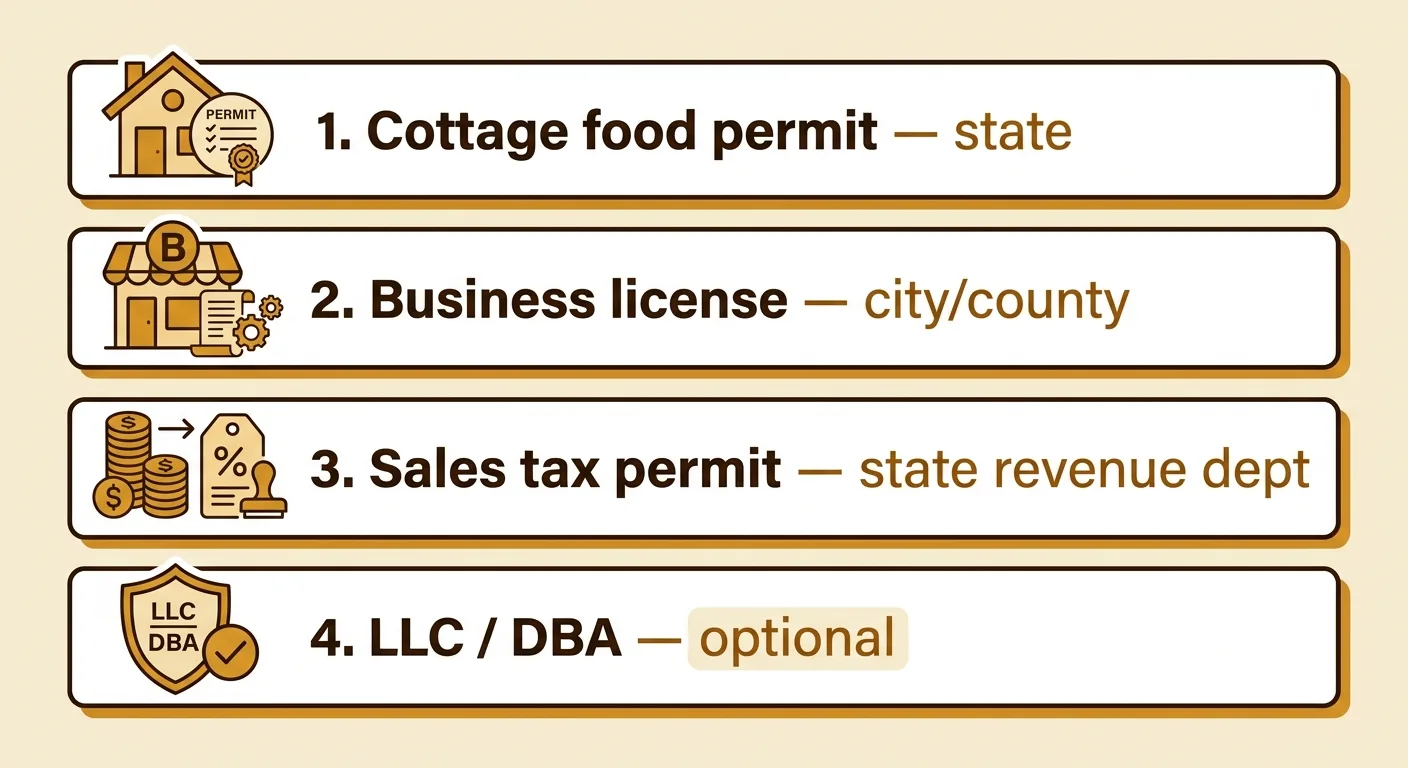
Notice that each of these four comes from a different office: the state Department of Agriculture (or Health), your city or county clerk's office, your state Department of Revenue, and your state's Secretary of State. That's the real reason there's no single, one-size-fits-all answer — you're not checking one rulebook, you're checking four, and each one is written by a different government with a different goal.
Does Your State Even Require a Cottage Food Permit?
Before anything else, it's worth knowing that the first layer — the cottage food permit itself — is genuinely split down the middle across the country. This isn't a case where almost every state requires one and a few outliers don't; it's close to a coin flip.
Across our review of all 50 state cottage food guides, roughly half of states require no cottage food permit or registration at all, and the other half require some form of registration or permit — often with a home-kitchen inspection required only once you cross into a higher sales tier. Neither situation is unusual. Neither is "the norm" that the other deviates from.
Where a permit fee does apply, it typically runs from about $30 to about $355 per year (or per permit term, since some states issue multi-year permits). We break down how much a cottage food license costs in every state separately; a few verified examples here, so you have real numbers instead of a vague range:
- Delaware — about $30 per year
- Kentucky — $50 per year
- California — $100 to $500, depending on which permit class (Class A vs. Class B) you fall into
- Washington — $355, but that covers a two-year permit
Plenty of states that do require a permit charge nothing at all for it — the registration itself is the entire requirement, no fee attached. And some states require neither a permit nor a fee for standard cottage food sales. Texas is the clearest example: no cottage food permit, no registration fee. If you're a Texas baker, layer one is already done — you can move straight to checking layers two through four.
At the other end of the spectrum sits a state like California, with its tiered Class A / Class B permit structure and a fee that scales with which class you fall into. Neither the no-permit end (Texas) nor the tiered-fee end (California) is the "normal" one — they're just two different, equally valid ways a state can choose to regulate cottage food. That's the whole point: the answer genuinely is state-specific, not a single national default with a few exceptions.
One more nuance worth knowing: some states use the word "registration" instead of "permit" or "license" — Minnesota is one — which can make the requirement feel lighter than it is. A registration can still come with its own product limits, sales caps, or renewal requirements, so don't assume "registration" means "nothing to track."
None of this is a substitute for checking your own state. The state cottage food law guides cover the exact permit rule, fee, and any inspection requirement for your specific state — that's where the real, current, per-state number lives.
Your Cottage Food Permit Is Not Your Business License
This is the section to actually slow down and read, because it's where most home bakers get tripped up — not from carelessness, but because it's a genuinely reasonable thing to assume incorrectly.
A cottage food permit or registration is a state saying: you may sell certain home-produced foods without meeting the licensing standards a commercial kitchen or restaurant has to meet. That's it. That's the entire scope of what it covers.
A general business license is a completely different thing. It's your city or county saying: you are allowed to operate a business — any business — at your address. It has nothing to do with food safety specifically. It's the same kind of approval a dog-walking business, a freelance bookkeeper, or a home-based tutor might need in the same city.
These two approvals come from different governments and answer different questions. Having one — or being exempt from one — tells you nothing about the other. A state cottage food exemption gets you out of state food-facility licensing. It does not exempt you from your city or county's general business-license, zoning, or home-occupation rules. Those are set locally, and your state's cottage food law simply isn't the document that governs them.
The mistake home bakers make most often is assuming that because their state's cottage food law didn't mention a business license, none is required anywhere. What actually happened is that the state law wasn't the place a local business-license requirement would ever appear — it's not that state's rule to set. The fix is straightforward, if unglamorous: call or search your city or county clerk's office, or your local business-licensing office, and ask specifically whether a home-based food business needs a general business license, a home-occupation permit, or a zoning sign-off. Do this in addition to checking your state's cottage food rule, not instead of it.
This also runs the other direction, and it's worth flagging because it surprises people just as often: a city that requires a general business license for every home-based business doesn't care that you're exempt from state food-facility licensing under your cottage food law. Your cottage food permit answers "can the state let me sell home-baked goods without a commercial kitchen." Your city's business license answers "can this city let a business, of any kind, operate at this residential address." A yes to one is not evidence for the other, and a local clerk's office isn't going to accept "I have a state cottage food registration" as a substitute for their own paperwork. Treat the two as fully independent checks, because that's what they legally are.
Do You Need a Sales Tax Permit?
This is the third, and entirely separate, question — and it belongs to your state's Department of Revenue, not your Department of Agriculture or your city clerk.
Whether your baked goods are taxable varies by state. Some states exempt most grocery-style food from sales tax; others tax prepared or ready-to-eat food, which can include what a cottage food operation sells. If your sales are taxable in your state, you generally need to register for a sales tax permit (sometimes called a seller's permit) and collect that tax on each sale.
This is independent of both the cottage food permit and the business license. You could be in a state that requires no cottage food permit and no local business license, and still owe sales tax on your baked goods — or the reverse. None of the three answers predicts the others.
The honest action here is the same one that applies to the rest of this guide: check your state's Department of Revenue website (or call them) and ask directly whether home-produced baked goods sold under your state's cottage food law are taxable, and if so, what registering to collect that tax requires.
Do You Need an LLC or DBA?
The fourth layer is the one with the most flexibility, and it's also the one most likely to get misrepresented online as mandatory. It isn't.
Most home bakers can legally operate as a sole proprietor under their own legal name, with nothing to file at the state level for the business structure itself. If you want to operate under a business name instead of your own name — "Riverside Bread Co." instead of your legal name — you'd typically file a DBA ("doing business as") with your state or county. An LLC goes a step further: it creates a legal separation between your personal assets and your business, which matters if you're worried about liability, but it's a structural and financial decision, not a food-safety requirement.
To be direct about it: you do not need an LLC to sell cottage food. It's optional. Plenty of home bakers run a fully compliant, fully legal cottage food business as sole proprietors indefinitely. Forming an LLC is worth considering as your sales grow and your risk exposure grows with them — but it's a choice about business structure and personal liability, entirely separate from whether your cottage food permit, business license, or sales tax obligations are in order.
A DBA is the middle option worth knowing about even if you never form an LLC: it doesn't change your liability at all, but it lets you legally use a business name — "Riverside Bread Co." — on your labels, your storefront, and your bank account, instead of operating under your own legal name. Filing one is typically a short form and a small fee at the county or state level, and it's a completely separate decision from your cottage food permit, your local business license, and your sales tax registration. None of the four layers in this guide depends on which of these three structures (sole proprietor, DBA, or LLC) you pick — they can be answered in any order, or all at once.
How to Find Out Exactly What YOU Need
Here's the concrete version — the checklist you can actually work through, in order, instead of trying to research all four layers simultaneously and losing track of which answer belongs to which question.
- Check your STATE cottage food rule. Is a permit or registration required? Is there a fee? Is a home-kitchen inspection required at your sales volume? Start with the state cottage food law guides for your state's specifics.
- Call or search your CITY or COUNTY for a general business license. Ask specifically about home-occupation rules and zoning for a home-based food business — this is the layer most often skipped, and it's set locally, not by your state's cottage food law.
- Check your STATE Department of Revenue for whether you need to register and collect sales tax on your baked goods.
- Decide your business structure. Sole proprietor (usually nothing to file), DBA (if you want a business name), or LLC (if you want liability separation). None of these three is legally required to sell cottage food.
- Handle the operational compliance your cottage food law actually requires — labels, most of all. Once you know what applies to you, a MyPorch storefront handles compliant labels and online ordering so the operational side runs itself.
Working through these five in order — instead of researching them all at once — is the difference between a clear answer and an afternoon of conflicting search results.
For the underlying question of whether selling from home is legal at all, Is It Legal to Sell Baked Goods From Home? covers the foundation this article builds on. And if you're just getting started end to end, How to Start a Home Bakery walks through the full setup, from your state's law to your first order.
Frequently Asked Questions
The real answer to "do I need a business license for cottage food" was never going to fit in one sentence, because it isn't one question. Check your state's cottage food rule, check your city or county for a general business license, check your state's Department of Revenue for sales tax, and decide your business structure on your own terms. Get those four answers and you'll know exactly where you stand — no guessing, and no borrowing someone else's answer from a different state.