
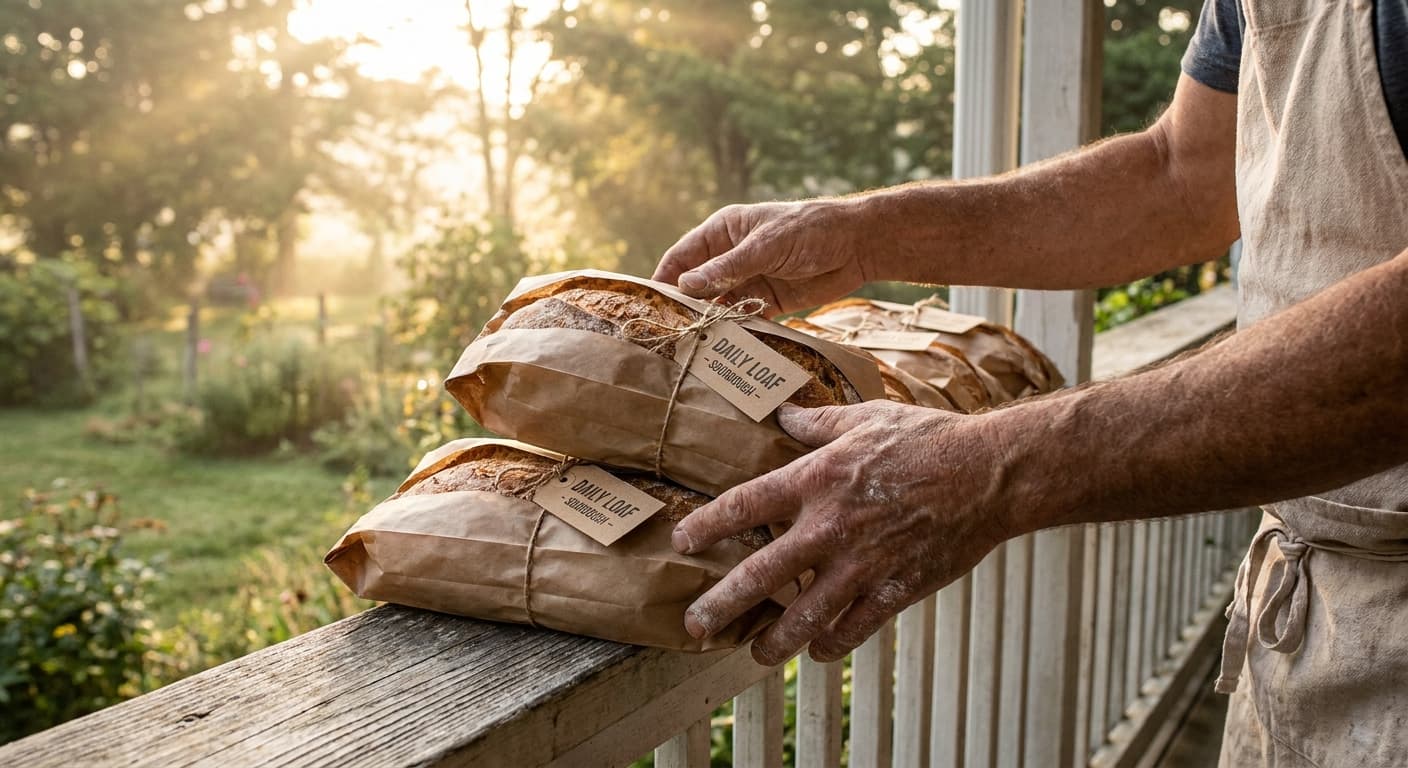
You have probably already made your first sale. It likely started when a neighbor smelled sourdough cooling on your counter, or a friend asked if they could pay you for a dozen cookies. You sold a few loaves, made a few dollars, and realized you could actually do this.
You can. And you can start this weekend.
In every U.S. state, cottage food laws allow home bakers to sell directly to customers from their residential kitchen — with real limits on what you can sell, where you can sell it, and how much you can earn before additional regulations apply. The rules vary enough by state that "home bakery legal requirements" is not one answer — it is fifty.
This guide is for home bakers who want to run a porch-pickup operation: selling pre-ordered bread, cookies, cakes, or other baked goods to local customers through a weekly batch model. It is not written for farmers market vendors, custom cake decorators, or anyone planning to wholesale to restaurants or stores. Those models involve different permits, different food safety standards, and different workflows.
By the end, you will know how to check your state's cottage food law, what products you can legally sell, how to price your bakes without undercutting yourself, what has to go on your label, and how to take your first order without managing it through a DM inbox and a spreadsheet.
A note before you start: this is more complicated than most guides admit — not in a way that should stop you, but in a way that means a few decisions made correctly upfront are much easier than correcting them later.
What Is a Home Bakery?
A home bakery is a food business operating out of a private residential kitchen under cottage food law — a category of state regulations that allow home food producers to sell certain foods directly to consumers without the commercial kitchen standards, health inspections, or licensing requirements that restaurants and retail bakeries follow.
The traditional path to a bakery used to be: hobby → commercial kitchen → retail storefront. The modern path is simpler: the porch-pickup.
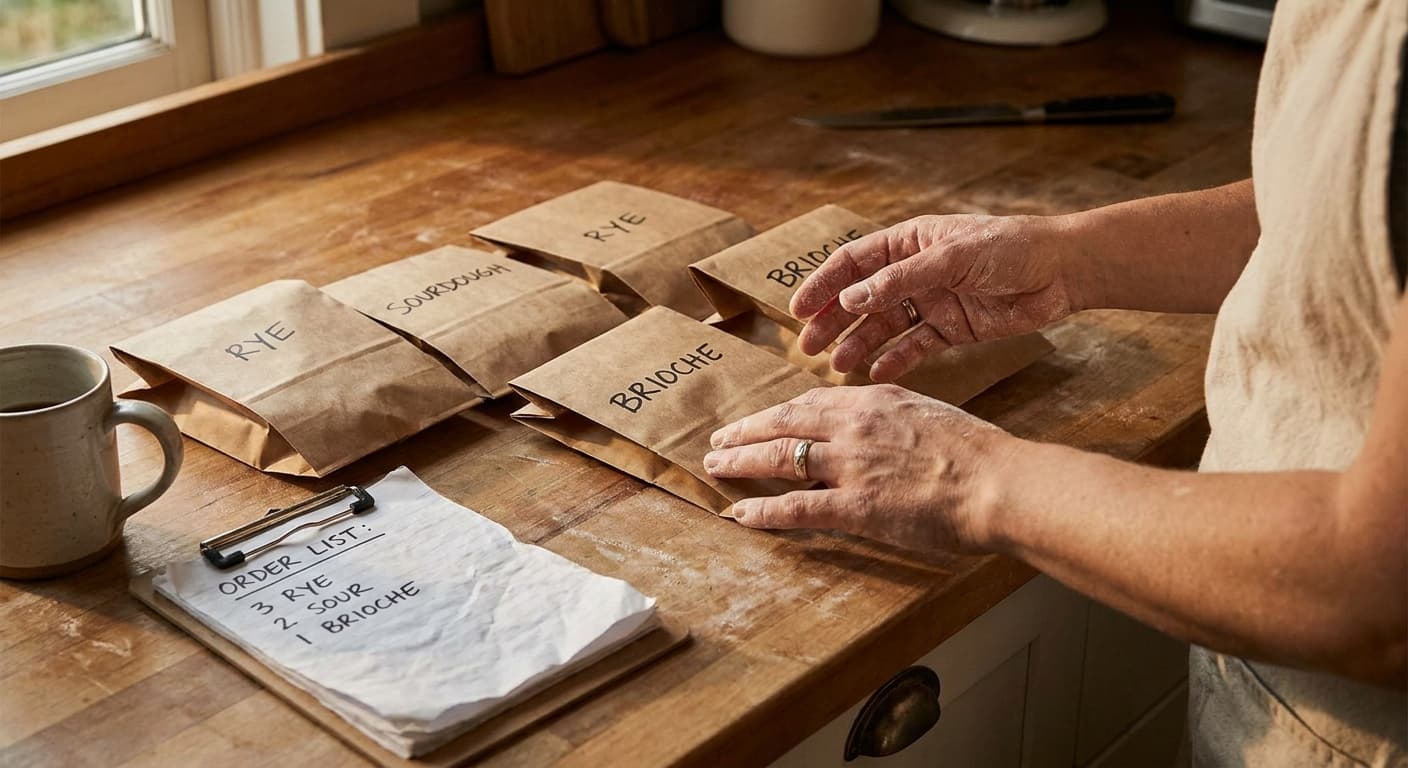
A porch-pickup baker opens a weekly batch, announces what she is making, collects pre-orders from neighbors and regulars, bakes on Thursday, and fulfills pickup Saturday morning. In the community, this is called a "bread drop" — not a "pre-order event." She talks about "my regulars," not her "loyal customer base." The tone is neighborly, not commercial, even when the math is decidedly business-like.
This model has real advantages over the alternatives:
- No overhead. Your kitchen is already equipped. Your oven is paid for. Startup costs are packaging, labels, and a few consumables.
- Predictable quantity. You bake what is ordered, not what you hope to sell. No guessing, no waste, no unsold inventory going stale.
- Flexible schedule. You set the order window, the batch size, and the pickup time. One bake day a week is a full operation for most bakers starting out.
- Real income from familiar products. Sourdough, cookies, cinnamon rolls, brownies — the things you already know how to bake.
“The porch-pickup model exists in every neighborhood in America. It does not require a website, a business license, or a storefront. It requires someone who bakes and knows ten people who want to eat.”
The difference between a batch-order and a custom-order model matters early. A custom-order baker takes individual commissions — a birthday cake, a custom cookie set — quoted separately, fulfilled on the customer's timeline. A batch baker sets a menu, opens an ordering window, bakes everything at once for a single pickup event, and closes the batch when orders are full. Batch baking captures economies of scale. Custom ordering destroys production efficiency because you are baking small, one-off quantities one at a time.
Is It Legal? Navigating Cottage Food Laws
Yes — in every U.S. state, under cottage food law.
Cottage food laws allow home bakers to sell certain low-risk foods directly to consumers without a commercial kitchen, without the food safety inspections that restaurants face, and often without a permit — and in most states, without a fee either. The specific rules vary significantly by state.
The common framework across most states:
- Allowed products. Baked goods are universally permitted: breads, cookies, cakes, muffins, pies, brownies. Potentially hazardous foods — anything requiring refrigeration, like cream-filled pastries or cheesecakes — are typically excluded.
- Revenue caps. Most states cap annual gross sales for cottage food operations. The range runs from $15,000 in some states to $75,000 in others. Washington caps at $35,000. Texas has no cap.
- Direct sales only. Almost all cottage food laws restrict sales to direct-to-consumer transactions. You sell to the person eating it — not to a restaurant, grocery store, or retailer.
- Labeling requirements. Every state requires a disclaimer on the label stating the product was made in a home kitchen not inspected by the state health department. The exact wording is defined by statute and is not paraphraseable.
How State Laws Vary
A few examples of how different each state's approach can be:
- Texas has no annual revenue cap and requires a basic food handler's certificate. Sales must be in-person and direct.
- California has two permit tiers: Class A for direct sales with a $75,000 cap, and Class B for direct and some local indirect sales.
- New York calls it the Home Processor Exemption. There is no sales cap, and it allows sales within the state without a permit.
- Pennsylvania calls its category a Limited Food Establishment. It requires a home kitchen inspection but allows significantly more volume than many states.
- Illinois requires registration with your county health department and mandates this exact disclaimer on every label: "This product was produced in a home kitchen not inspected by a health department that may also process common food allergens."
The variation is real. Never assume your neighbor's experience in another state applies to yours.
How to Find Your State's Law
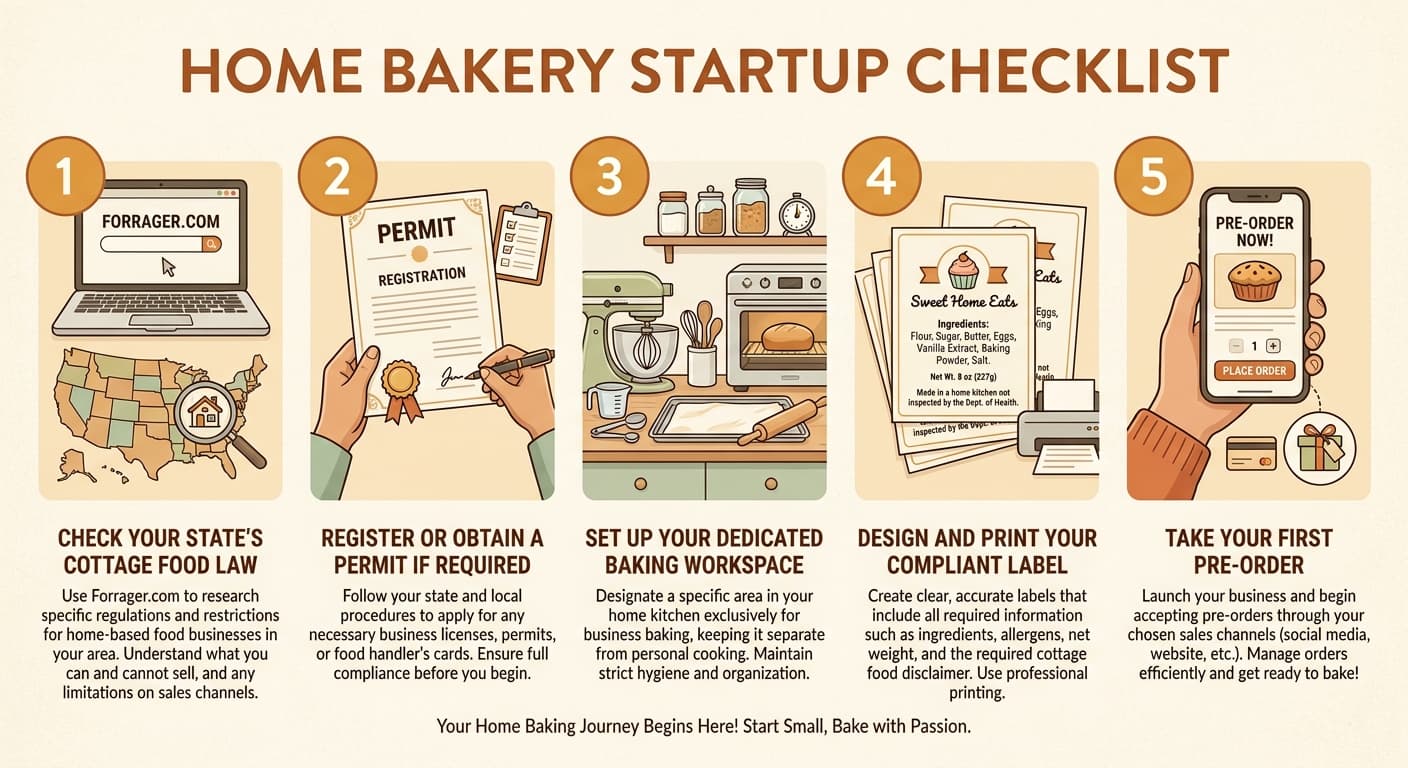
The fastest starting point: Forrager.com maintains updated summaries of cottage food laws across all 50 states. For the primary source, your state's Department of Agriculture or Department of Health website is where the statute lives.
MyPorch publishes detailed guides for many states — each includes the revenue cap, permitted sales channels, allowed products, and the verbatim disclaimer wording required for your label. Check the state cottage food law guides if yours is available.
What to look for when reading your state's law:
- Is a permit or registration required? Many states have no requirement; others require a simple registration, a food handler's certification, or a permit from the state Department of Agriculture.
- What is the annual revenue cap? Know this before you plan capacity or pricing.
- What is the exact wording of the required disclaimer? Copy it verbatim — the language is typically defined in statute.
- Are online sales permitted? Some states restrict sales to in-person transactions. Others explicitly allow website orders for local pickup.
- Are farmers markets covered? If you plan to sell at markets in addition to porch pickup, confirm that your state's law covers both sales channels.
What Can You Sell?
Most home bakers start with what they already make well. That is the right call — selling what you are confident in is better than learning a new product and selling it simultaneously. But knowing which products are definitely permitted, which are not, and which fall into conditional territory prevents problems later.
| Product | Typically Permitted | Notes |
|---|---|---|
| Breads (sourdough, sandwich, enriched) | ✅ Yes | Universal |
| Cookies and bars | ✅ Yes | Universal |
| Muffins, scones, quick breads | ✅ Yes | Universal |
| Cakes (shelf-stable frosting) | ✅ Yes | Buttercream, ganache, fondant typically fine |
| Brownies and fudge | ✅ Yes | Universal |
| Fruit and nut pies | ✅ Yes | Most states |
| Dog treats (shelf-stable) | ✅ Often | Some states regulate pet food separately — confirm |
| Cream-filled pastries | ❌ No | Requires refrigeration |
| Cheesecake | ❌ No | Requires refrigeration |
| Custard tarts, eclairs | ❌ No | Requires refrigeration |
| Fresh pasta | ❌ Rarely | Different food category, not a baked good |
| Low-acid canned goods (pickles, salsa) | ❌ No | Separate cottage food category in most states |
The practical shorthand is the refrigeration test: if it would spoil at room temperature within a few hours, it almost certainly falls outside cottage food protection and into a more regulated food category.
Setting Up Your Kitchen
The good news: you are probably already set up.
Cottage food law does not require a commercial kitchen. Your residential kitchen is where you can legally operate. The setup considerations are practical, not regulatory.
Equipment you likely already have:
- Stand mixer or hand mixer
- Oven (most home ovens handle standard cottage food volumes fine)
- Sheet pans, loaf pans, cooling racks
- Kitchen scale (weigh everything — consistency is easier and product quality is better)
- Instant-read thermometer
Equipment worth upgrading early:
- Extra sheet pans and loaf pans. When you go from baking for yourself to a full batch, you hit pan capacity fast. A second set of whatever you bake most often pays for itself quickly.
- A dedicated packaging workspace. Even a cleared counter area helps when you are sealing bags, printing labels, and staging orders for pickup at the same time.
Food safety practices that matter:
Your cottage food exemption does not exempt you from basic food safety. Cross-contamination, allergen management, and sanitation standards still apply — both for legal reasons and because a customer who gets sick from a home bakery order is an outcome that ends operations.
- Keep raw proteins and eggs away from finished products.
- If you handle common allergens (tree nuts, peanuts) alongside non-allergen products, change gloves and clean surfaces between batches.
- If you make products with and without gluten, shared equipment is a real problem. Customers with celiac disease cannot safely consume products from kitchens that also handle wheat, even if the specific product contains no gluten — and they will ask.
- Many states explicitly require that pets be excluded from the kitchen area during preparation, packaging, and handling of cottage food products. Check your state's law.
- Label your allergens. Every state requires it, and it is the right thing to do regardless.
Pricing Your Baked Goods
This is where most home bakers leave real money behind.
The math for pricing baked goods is not complicated. The psychology is.
The four-part price formula:
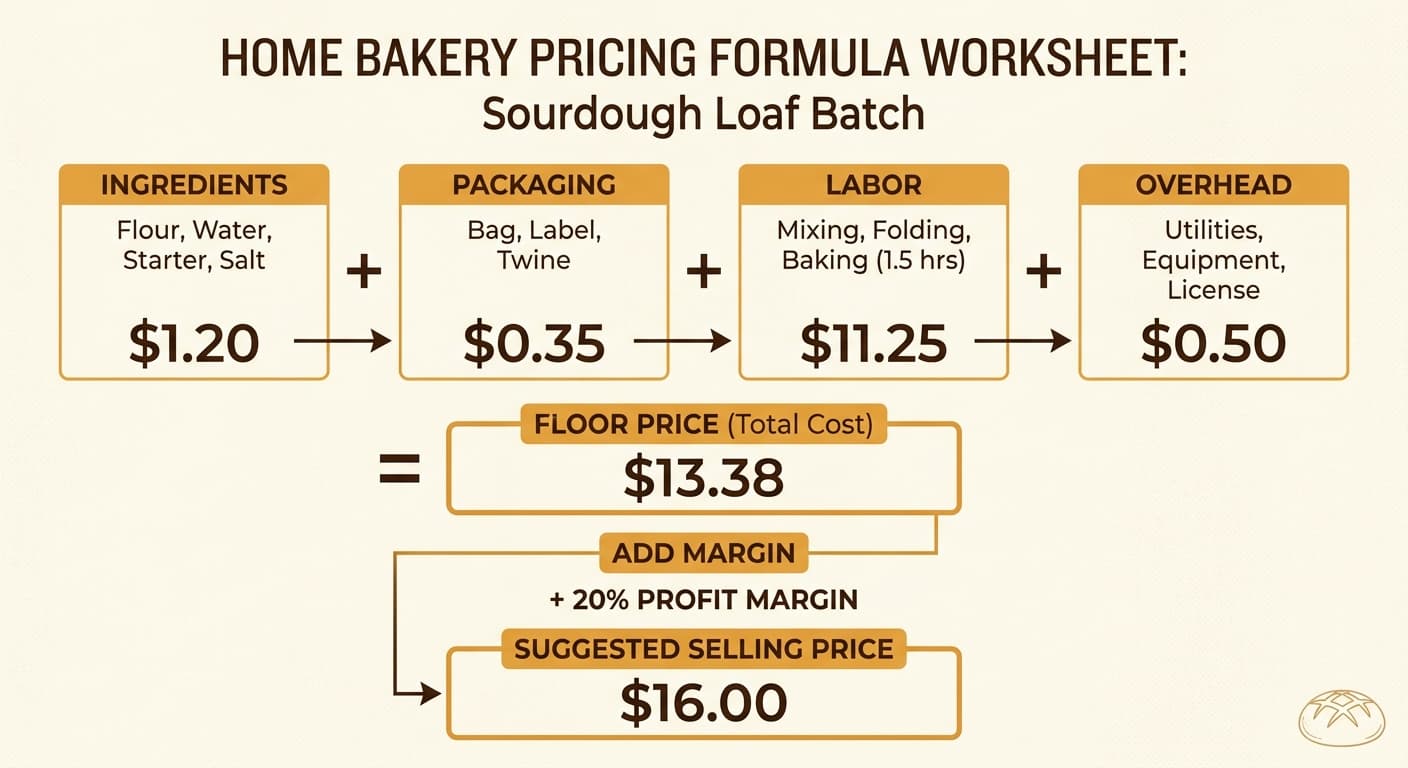
Ingredient cost + Packaging cost + Labor + Margin = Selling price
Here is what that looks like for a common product:
Example: One sourdough loaf
| Cost component | Amount |
|---|---|
| Ingredients (flour, water, salt, starter) | $1.20 |
| Packaging (bag, twist tie) | $0.35 |
| Label | $0.08 |
| Labor: 3 hours across 4 loaves at $15/hr | $11.25 |
| Overhead (electricity, water) | $0.50 |
| Subtotal (floor price) | $13.38 |
| Margin (20%) | $2.68 |
| Suggested selling price | $16.00 |
Most bakers selling sourdough charge $10–$12. A few charge $14–$16. The ones charging $14–$16 are not making a different product — they are doing the math and not rounding down.
The guilt discount. There is a specific psychological trap that catches almost every home baker who sells to people they know: you feel uncomfortable charging a neighbor what a professional bakery would charge. The price feels high. You apply an unconscious discount. You add a free extra. You tell yourself it is community spirit.
The problem is that you do not get that feeling at the farmers market next week. You do not get it at the specialty grocery store. Those operations charge what the product is worth. When you round down because the customer is your neighbor's friend, you are subsidizing their grocery budget out of your labor budget.
Charge the real price. If a neighbor genuinely cannot afford it, that is a separate conversation. But start at the real price.
“Most sourdough bakers price at $10 when the formula says $14–16. The gap is not about the product. It is about charging a neighbor what the work is worth.”
A practical note on labor tracking. The labor number is the one bakers almost always undercount. Active baking time is easy to measure. Shopping, cleaning, packaging, and managing order communication are not. Track your total time on a full batch weekend at least twice before you lock in pricing. Most bakers discover their real effective hourly rate is somewhere between $8–$12 when they do this honestly — and then they adjust their prices up.
Cottage Food Labeling Requirements
Every cottage food product you sell needs a label. This is a legal requirement, not a branding suggestion. Handing a customer an unmarked bag is a violation of state law.
The core elements required by most states:
- Product name — A common or usual name. "Sourdough Bread," not "Country Loaf No. 3."
- Business name — Your bakery's name.
- Address — Your residential address. Most states do not accept P.O. Boxes — the law typically requires a physical home address.
- Ingredients list — In descending order by weight.
- Allergen disclosure — "Contains: wheat, eggs, milk" or equivalent. Required by federal law and most state cottage food laws.
- Net weight — In both metric and imperial in most states.
- Cottage food disclaimer — The specific language is defined by your state's law. In Washington, it must read: "Made in a Home Kitchen that has not been subject to standard inspection criteria" in minimum 11-point type. In Ohio, the required wording is: "This product is home produced." Copy it verbatim — paraphrasing does not satisfy the legal requirement.
- Production date — Required in some states, strongly recommended in all.
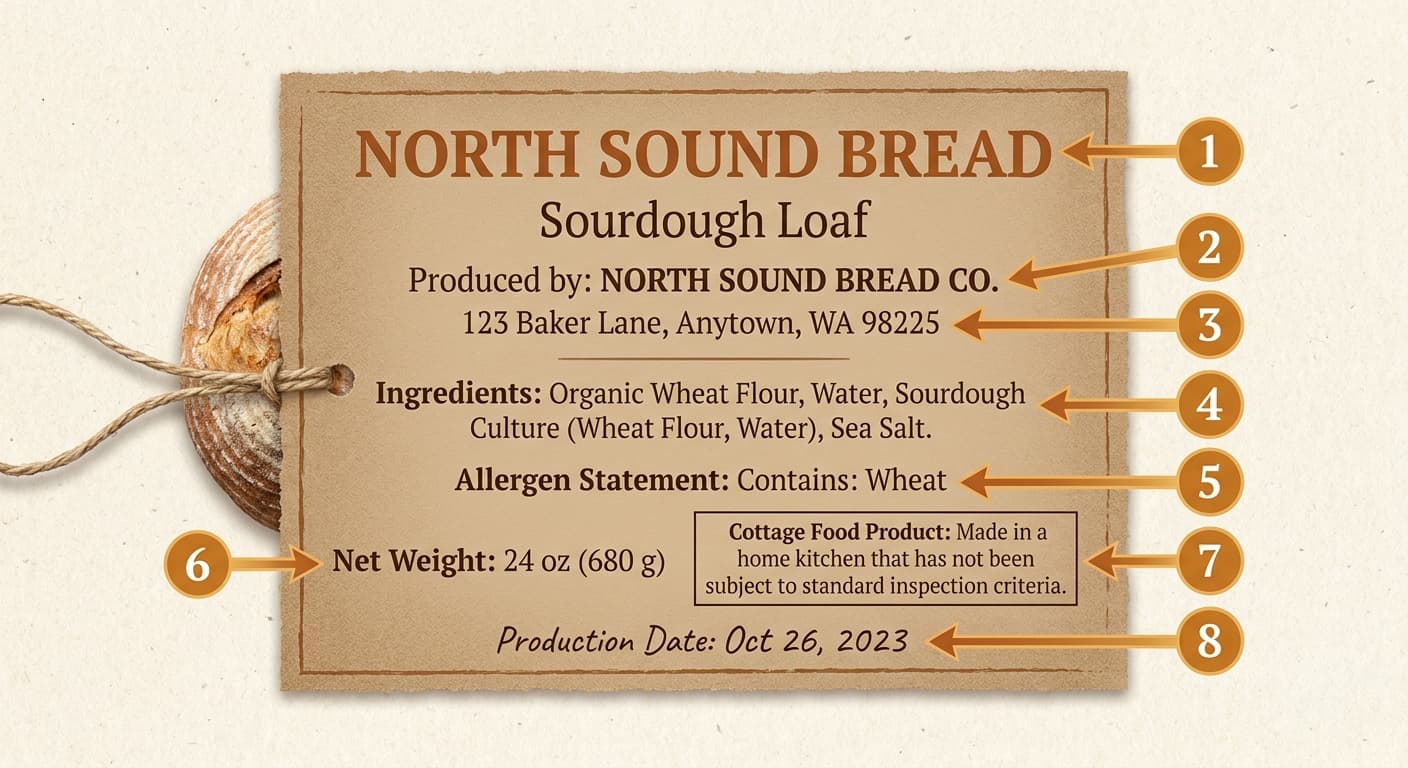
The disclaimer is the element that catches most new bakers off guard. Before you print a single label, look up the exact required disclaimer wording for your state.
For a full breakdown of what goes on the label, where on the label it must appear, and how requirements differ by state, see the Cottage Food Labeling Requirements guide.
Marketing Your Home Bakery
The most effective marketing channel for a porch-pickup baker is the same one it has always been: a satisfied neighbor who tells another neighbor.
That is not a retreat from digital strategy — it is the sequence. Your first ten customers come from existing relationships. Your next twenty come from those ten telling their networks. The Instagram following comes third, not first.
Finding your first customers:
- Tell the people you already know. Your neighbors, your parent group, your coworkers, anyone in a neighborhood Facebook group or Nextdoor. You do not need a pitch. "I baked a sourdough loaf and I have a couple extra — want to buy one?" is sufficient.
- Post in local community groups. A neighborhood Facebook group or Nextdoor is a warm, free audience for a local food business. Your first post can be simple: a photo of what you make and how to order.
- Farmers markets (if your state allows them). A single market appearance puts your products in front of people who are already looking for local food. A few dozen customers who met you at the market become regulars who look for your weekly batch announcement.
Content that actually works on social media:
The content that performs for home bakers is not promotional — it is process. A video of shaping sourdough gets more engagement than a styled flatlay of finished loaves. A story of a failed batch — the one where the starter was off and the crumb was tight — builds more trust than perfectly lit product photography.
One unfiltered photo of your real bake setup at 6am on Friday will out-perform a staged product shot almost every time with this audience.
The weekly announcement. Once you have regulars, your most important marketing tool is a consistent weekly announcement — same day, same format, same time. "Monday morning: batch opens. Wednesday night: it closes." Consistency trains your audience to look for you. Inconsistency trains them to check elsewhere.
The 15-Order Wall
At some point — usually around the fifteenth order a week — the system that got you here stops working.
Not all at once. The failure is gradual. A DM that sat in a filtered folder for two days. A spreadsheet row where you are not sure if Sarah M. paid or if you just thought she did. A message request from someone who wanted a rye loaf, sent four days ago. You never replied. You do not have enough dough mixed to add one now.
This is not a personal failure. It is what happens when the right tools for a small operation — a DM inbox, a spreadsheet, and a payment app — get asked to manage a medium one.
The specific failures that appear above the wall:
Inventory oversells. Two customers DM about the same last loaf. You confirm it to both. One of them shows up Saturday and you have nothing for them.
Messages get missed. Instagram DMs, Facebook Messenger, texts, and email are four separate inboxes. A message in the wrong one sits unread until after pickup.
Bake day starts with guesswork. You pull up your spreadsheet at 6am Friday and realize you have not reconciled it with your DMs since Tuesday. You do not actually know how many cinnamon rolls you need to make.
Payment is unconfirmed. A customer orders, does not send payment until the day before, and you are not sure if they are actually coming. You baked for them anyway. They do not show.
“The 15-order wall is not a failure. It is a sign that what you built is working — you have just outgrown it.”
If you are not at fifteen orders yet, you do not need a dedicated system today. But knowing what you are building toward makes it easier to set up before you hit the wall than after.
Setting Up Your Orders: The Next Step
The standard advice at this point is "use an order form." A Google Form is better than a DM. A spreadsheet connected to that form is better than a spreadsheet you maintain by hand.
But neither of those solves the full problem.
The gap between "I have a form" and "I have a working order system" includes: a way for customers to see what is available and in what quantity, automatic payment collection so you know an order is confirmed, order confirmation sent without manual effort, a bake list that generates from the orders, and labels that print from the same system.
When all of those pieces are connected, bake day becomes logistics. When they are separate — a form here, a payment app there, a spreadsheet you update by hand — it stays archaeology.
A dedicated pre-order storefront is what connects those pieces. Your customers see your batch menu with live availability, order and pay in one step, receive automatic confirmation, and get a pickup reminder the day before. You get an order dashboard, a bake list, and labels that generate from what was ordered. When an item hits its quantity cap, it automatically shows as sold out — no manual tracking, no double-booking.
If you are managing more than fifteen orders a week through texts and DMs, set up your free MyPorch storefront in about 15 minutes. The free plan covers your first 10 orders per month. No credit card needed.
For more on how to structure your order window, batch menu, and pickup communication, see How to Take Pre-Orders for Your Home Bakery.
Common Mistakes to Avoid
Undercharging from the start. Setting a low price because you are new and feel like you need to earn the right to charge real rates creates a problem that is hard to fix later. Customers anchor to the first price they see. Raising prices on existing customers is uncomfortable. Do the math before your first order and charge the real price from day one.
Missing the disclaimer. The cottage food disclaimer is the one label element with real legal exposure. Every label, every batch, every product — no exceptions.
Ignoring local ordinances. State cottage food law is the floor, not the ceiling. Some counties, cities, and HOAs have additional restrictions: zoning rules, limits on traffic at a residential address, local food safety requirements, or signage rules. A neighbor complaint about cars blocking the street during Saturday pickup is a real problem that state law does not protect against. Check with your local health department and know your HOA rules before your first pickup.
Not knowing your revenue cap. In most states, exceeding the annual revenue cap on cottage food sales means you are no longer protected by the cottage food exemption. That means different permits, potentially a commercial kitchen, and a reclassification of your operation. Know your cap and track your gross sales from the first order.
Baking without confirmed orders. Making twenty extra loaves because you expect demand this week and then not selling them is the fastest way to kill your profit margins. The pre-order model exists to solve this. Only bake what is ordered.
Frequently Asked Questions
Do I need a permit to start a home bakery?
It depends on your state. Many states have no permit requirement for cottage food operations. Others require a simple registration, a food handler's certification, or a permit from the state Department of Agriculture or local health department. Forrager.com is the fastest starting point — look up your state and then verify against the official primary source.
How do I register my home bakery?
In states that require registration, visit your state's Department of Agriculture website and search for the "cottage food" or "home processor" registration portal. Some states process applications through the local health department at the county level. The specific office varies — your state's cottage food law will name the issuing agency.
What are the startup costs for a home bakery?
Lower than most guides suggest. Your kitchen equipment — mixer, oven, sheet pans — is already paid for. The actual startup costs are packaging ($30–$80 for an initial supply of bags and labels) and the ingredients for your first batch. Most home bakers start for under $200.
Can I sell my baked goods online?
It depends on your state. Some states explicitly allow online orders for local pickup. Others restrict sales to in-person transactions. A few allow shipping within state lines. The sales channel rules are one of the most variable parts of cottage food regulation — check your state's law specifically.
How much can I realistically earn?
A single bake day per week producing 20 sourdough loaves at $14 each generates $280 gross. Subtract $24 in ingredients, $7 in packaging, and roughly $50 in labor tracked honestly: net is around $199 for one bake day — roughly $800 a month from a single weekly batch. More products, more batches, or higher prices change the number, but that is a realistic floor for a consistent, modest operation.
Do I need business insurance?
Technically optional for most cottage food operations, but practically worth having. A general liability policy for a home food business typically runs $300–$600 per year. It protects you if a customer claims illness or if something goes wrong at pickup. Your homeowner's insurance almost certainly does not cover a home-based food business — confirm before assuming it does.
How do I prevent double-booking pre-orders?
Use a system where product quantity is tracked in real time against confirmed orders. In a spreadsheet-and-DM setup, the only way to prevent overselling is to manually update a running count every time someone orders — which means you will miss something the moment you are away from your phone. A storefront with live inventory caps solves this by design: when the last loaf is claimed, the item shows as sold out automatically.
Starting a home bakery is mostly legwork upfront: check your state's law, price honestly before your first order, get your label right, and have a plan for managing orders before you need to manage them.
The first batch is the easiest version of the problem. The fifteenth week is where the real system gets tested. Get the foundation right now and you will not have to rebuild it when demand catches up.