The realization usually comes from the outside.
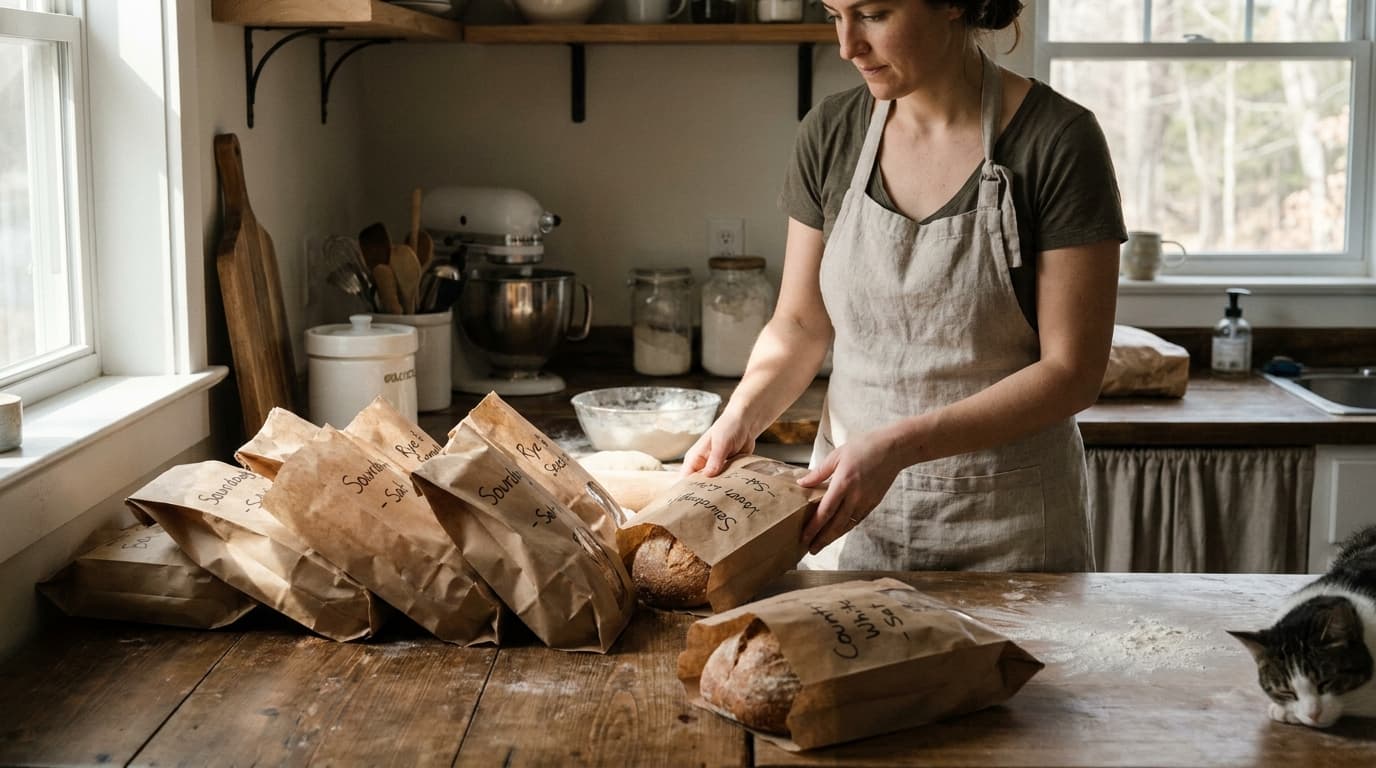
A neighbor says something like "I told my coworker about your bread — she wants to know if she can order." A friend texts: "Are you doing a batch this weekend? I need two loaves." Someone you barely know asks if you take Venmo. They are treating you like a microbakery.
And you think: I am just baking. I am not running a business.
But you have a pickup window. You have people who come back every week. You have a Wednesday cutoff — not because you read it in a guide, but because you learned, through experience, that you need two full days to bake and you cannot add a loaf at 7am Saturday for someone who texted at 6.
You have regulars. You have a system. You have, whether or not you called it that, a microbakery.
A microbakery is a licensed home-based baking business that sells baked goods to the public, operating under state cottage food laws rather than commercial bakery regulations.
That is the definition. The rest of this guide is what it means in practice — the legal framework, the weekly rhythm, the real math, and the specific point where casual baking becomes something more deliberate.
What Makes a Microbakery a Microbakery
The term does not have a legal definition. You will not find "microbakery" in any state statute. What states regulate is the underlying business model — cottage food production — and microbakery is the word the community settled on to describe that model when it is run as a real, recurring operation rather than occasional informal sales.
Three things distinguish a microbakery from other baking businesses:
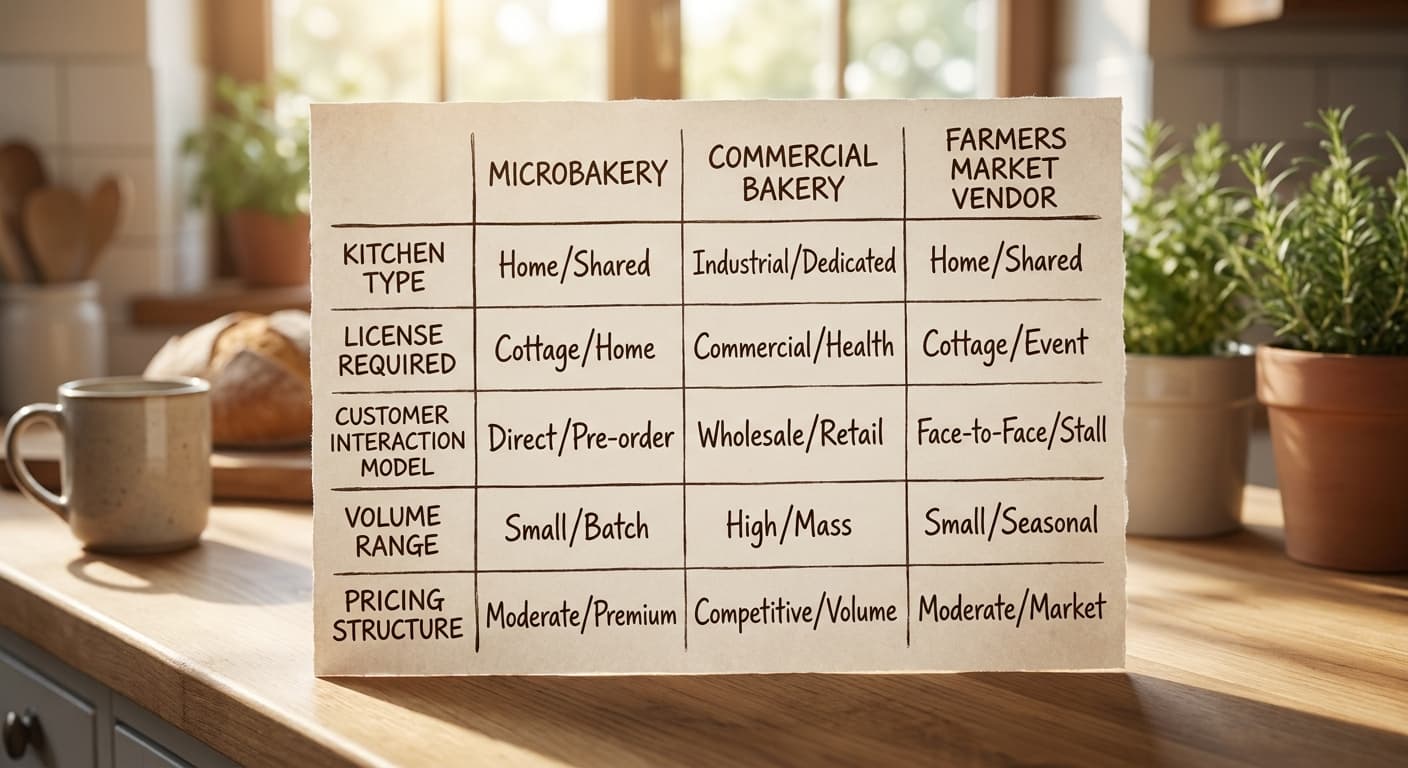
Location. Production happens in a home kitchen, not a licensed commercial facility. This is the defining legal characteristic. Cottage food laws exist specifically to allow home kitchen production for certain categories of lower-risk foods — jams, breads, cookies, dry mixes — without requiring a commercial kitchen license.
Scale. A microbakery operates below the revenue thresholds and volume caps set by state cottage food law. In most states this means somewhere between $25,000 and $75,000 in annual gross sales. Above that threshold, a commercial kitchen license is typically required. Below it, the home kitchen is the legal production space.
Customer relationship. A microbakery sells directly to the end consumer — a neighbor, a regular, someone from the neighborhood group chat — not to retailers, restaurants, or wholesale buyers. Cottage food laws almost universally prohibit third-party resale.
What a microbakery is not: a hobbyist baker who occasionally gives things away and accepts payment by mutual agreement. That is a different arrangement, without the formality of licensing, labeling, or registered sales. A microbakery operates under a permit, with compliant labels, with declared income. It is a small business. A very small one, run out of a home kitchen, but a business.
The Three Microbakery Models
"Microbakery" gets used loosely to describe three meaningfully different operations. The differences matter because the legal requirements, the workflows, and the practical challenges are distinct.
1. The Porch-Pickup Baker
This is the bread drop. The weekly menu. The Saturday haul. You open a weekly batch, announce what you are making and how many you have, collect orders and payment in advance, bake to fill those specific orders, and customers come to you during a set pickup window. Your regulars are loyal. Your inventory is spoken for before you mix a gram of flour.
This guide — and the MyPorch platform — is written for this model. It carries the lowest financial risk and is the most sustainable way for a solo operator to grow.
2. The Farmers Market Vendor
This baker bakes on speculation. Stay up all night Thursday and Friday producing eighty loaves, load the car at 5am, set up a tent, and hope the foot traffic is good enough to sell out. High visibility and fast community integration — and the highest risk of wasted product and burnout of the three models.
3. The Custom-Order Baker
This is the wedding cake and bespoke cookie artist. Their workflow revolves around individual inquiries, custom quotes, and per-item price tags that reflect hours of detailed labor. Each order is one-off rather than batched.
The legal framework covers all three, but the workflows and tools are different enough that guides for custom-order bakers and market vendors exist separately.
The Legal Frame: Cottage Food Laws in One Section
A microbakery operates under your state's cottage food law. This is non-negotiable — if you are selling baked goods to the public, you are either operating legally under a cottage food license or you are operating without one. The short answer to whether it is legal: yes, in every U.S. state — the rules just vary significantly.
The good news: cottage food laws exist in all 50 states, and most of them are more permissive than bakers assume.
The variable: every state has its own rules, and the differences are significant.
Here is what cottage food laws typically govern:
What you can sell. Most states restrict sales to "non-potentially-hazardous" foods — baked goods, jams, dry mixes, candy. Products requiring refrigeration (custard, cream fillings, most cheesecakes) are usually excluded. The specific list varies by state.
Where you can sell. Most states require direct-to-consumer sales only. Many restrict sales to in-person transactions at a fixed location — your home, a farmers market, a community event. Some states allow online ordering with local pickup. A few allow shipping within state lines.
How much you can make. Annual gross revenue caps range from $20,000 to no cap at all, depending on state. Texas has no cap. California caps at $75,000. Most Midwest states sit somewhere between $25,000 and $50,000.
How your products must be labeled. Every state requires a label on every product you sell. The required elements vary — your name and address, an ingredient list, allergen declarations, a cottage food disclaimer — but every state requires them. This is the step most new microbakers skip or handle informally, and it is also the step most likely to create legal exposure.
The cottage food labeling requirements guide covers what needs to be on the label in detail. For state-by-state rules, Forrager.com maintains the most comprehensive and regularly updated state-by-state directory available.
The practical starting point: look up your state's cottage food law, register for a permit if your state requires one (most do), and label every product you sell. These three steps take an afternoon and are what separate a microbakery from informal selling.
What a Microbakery Looks Like Week to Week
The definition is useful. The rhythm is what actually matters.
A porch-pickup microbakery runs on a weekly cadence. The specific days move around, but the structure stays fixed:
Sunday evening — Preview. A photo of last week's crumb, a teaser of what is coming this week. You are not taking orders yet. You are reminding your regulars that you exist and giving them something to look forward to.
Monday morning — Orders open. You post the full batch menu: what is available, how many you are making, the price per item, the cutoff time, and the pickup window. Your most loyal regulars move fast. The availability is real — when the cinnamon rolls are gone, they are gone.
Wednesday at 8pm — Orders close. This is the non-negotiable. Everything that comes after depends on knowing exactly what you are making before you walk into the kitchen Thursday morning.
Thursday and Friday — You bake to fill the orders. You know your quantities before you shop. You mix exactly enough dough. You do not find out at 6am Saturday that you have ten loaves to make and three hours to do it.
Saturday morning — Pickup window opens. Customers come to the porch, take their labeled bags, and leave. The ones who could not make it send a family member or arrange a different time through a single text.
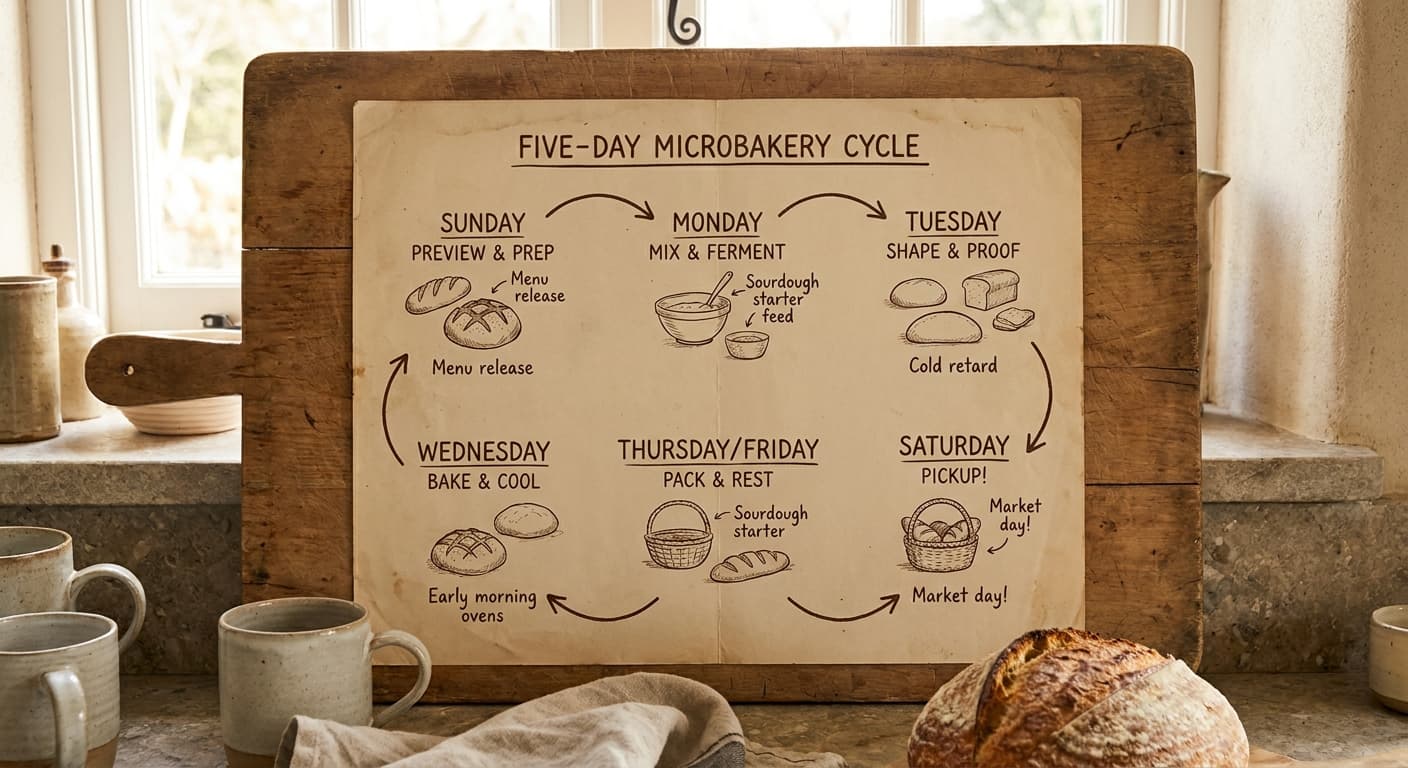
This is The Wednesday Rhythm. It is not just a scheduling choice — it is the structural commitment that separates a microbakery from casual baking. When you enforce a hard order cutoff, you know what you are making before you make it. You can plan your flour order, your time, your bake schedule. Your Thursday is protected. Your Saturday is logistics, not improvisation.
Bakers who run this rhythm for a month describe a specific shift: the anxiety of not knowing who is coming and what they want gets replaced by the calm of a production list. That shift is what it feels like to run a real operation.
The complete guide to taking pre-orders for your home bakery covers how to set up every piece of this system — from the order form to the bake list to the labels.
The Real Numbers
The most common question about microbakeries is whether they are worth running financially. The honest answer requires actual math, not a revenue range.
A typical porch-pickup operation: one bake day per week, 24 sourdough loaves at $14 each.
| Item | Per loaf | Total |
|---|---|---|
| Revenue | $14.00 | $336.00 |
| Ingredients | $2.20 | $52.80 |
| Packaging | $0.50 | $12.00 |
| Active labor (4 hours at $20/hr) | $3.35 | $80.00 |
| Net per batch | $7.95 | $191.20 |
One bake day per week, 52 weeks: \~$9,900/year.
Add a second product — 24 cinnamon rolls at $4 each, ingredient cost $0.80, packaging $0.25 — and the weekly net adds another $70. Annual total crosses $13,500.
That is not a primary income. It is a meaningful side income for a baker who enjoys the work and was going to bake anyway. The labor rate in that calculation is $20/hour — if the work itself is something you would do regardless, the effective return is higher.
The ceiling depends on your state's cottage food cap, how much you want to bake, and whether you add bake days. A baker running two bake days per week at capacity in a no-cap state is looking at $20,000–$30,000/year as a realistic ceiling for a home kitchen operation before the workflow complexity outpaces what one person can manage.
“Most bakers undercharge because they feel awkward charging neighbors the real price. The formula does not know your neighbors. Run the math, then set the price.”
Three Misconceptions Worth Correcting
"You need a commercial kitchen."
In almost every state, you do not — not for cottage food products. Cottage food laws exist specifically to allow production in licensed home kitchens. The licensing process typically involves registering with your local health department, agreeing to a set of kitchen standards (no pets in the kitchen during production, no lead paint on surfaces, that kind of thing), and paying a modest annual fee. A commercial kitchen is required if you want to produce high-risk foods not covered by cottage food law or if you exceed your state's revenue cap.
"You cannot make real money doing this."
You can make real money relative to the time invested, particularly if you are pricing correctly and running a tight batch system. The math above is real. The constraint is not the model — it is the willingness to price at cost-plus-margin rather than what feels comfortable to charge a neighbor. Most bakers who say they cannot make money from this are pricing their sourdough at $8 when the formula says $12–14.
"It is a hobby, not a business."
It is a business with lighter licensing requirements than a commercial bakery. The distinction matters for taxes (income is taxable), liability (a cottage food license provides a legal operating framework), and long-term sustainability (a hobby can stop whenever; a business has regulars who depend on it). Treating it like a hobby is how a baker ends up with untracked income, unlabeled products, and a system that cannot survive a bump in demand.
The Bridge: What Running One Actually Requires
Now that you know what a microbakery is — and you may realize you are already running one — here is what doing it properly requires.
- Get legal. Look up your state's cottage food law, register with your county health department, and pay the permit fee. Most states process permits within a few weeks. This is the step most bakers skip and the only one that actually creates legal exposure.
- Get your labels right. Every product that leaves your kitchen needs a compliant label. The cottage food labeling requirements guide covers exactly what belongs on it for your state.
- Get your orders in one place. The most common early failure is managing orders across DMs, texts, and Venmo with no central record. One form, one payment method, one list. The pre-order guide covers how to set the whole system up.
- Commit to the Wednesday Rhythm. Set a cutoff and hold it. Everything else — your shopping, your bake schedule, your labels, your Saturday pickup — gets easier the moment your quantities are locked before you start.
Frequently Asked Questions
Is a microbakery legal?
Yes, in all 50 states — operating under that state's cottage food law. The specific requirements vary significantly: what you can sell, where you can sell it, how it must be labeled, and how much you can make per year. Look up your state's cottage food law before selling anything. Forrager.com maintains an up-to-date directory.
Do I need a license for a microbakery?
Most states require a cottage food permit or registration. The process is usually straightforward — an application, a modest fee, and agreement to basic kitchen standards. Some states require a food handler's certification as well. A few states have no formal licensing requirement. The permit is what gives you legal standing to sell and is worth getting before you accept your first payment. Note that a cottage food permit is not the same as a local business license or sales tax registration — see Do I Need a Business License for Cottage Food? for how those layers differ.
How much can you make from a microbakery?
Realistically: $5,000–$15,000 per year for one bake day per week at steady volume, depending on what you sell and how you price it. The ceiling is set by your state's cottage food revenue cap (anywhere from $20,000 to no cap), how many bake days you want to run, and how tightly your production system is built. The math is specific to your products — use actual ingredient costs, real packaging costs, and an honest labor rate.
What is the difference between a microbakery and a cottage food business?
Cottage food is the legal framework. Microbakery is the operational model. All microbakeries operate under cottage food law; not all cottage food businesses operate as microbakeries. A neighbor who sells jam at one community event per year is a cottage food producer. A baker who runs a weekly batch with regulars, a pickup window, and a compliant labeling system is a microbakery.
What can I sell from a microbakery?
Most states permit breads, cookies, cakes, muffins, brownies, pastries, granola, dry mixes, candy, and jams under cottage food law. Products that require refrigeration — custard fillings, cream cheese frosting, fresh whipped cream — are excluded in most states. Check your state's specific permitted product list before adding anything new to your menu.
If you are already baking for neighbors, have regulars, and have figured out a Wednesday cutoff on your own — you have already built the hardest part. The rest is systems: a place for orders to land, labels that meet your state's requirements, and a rhythm you can sustain week after week.
MyPorch gives you the storefront, the order system, and labels that print from the same place the orders live. Free for your first 10 orders — no credit card required.