
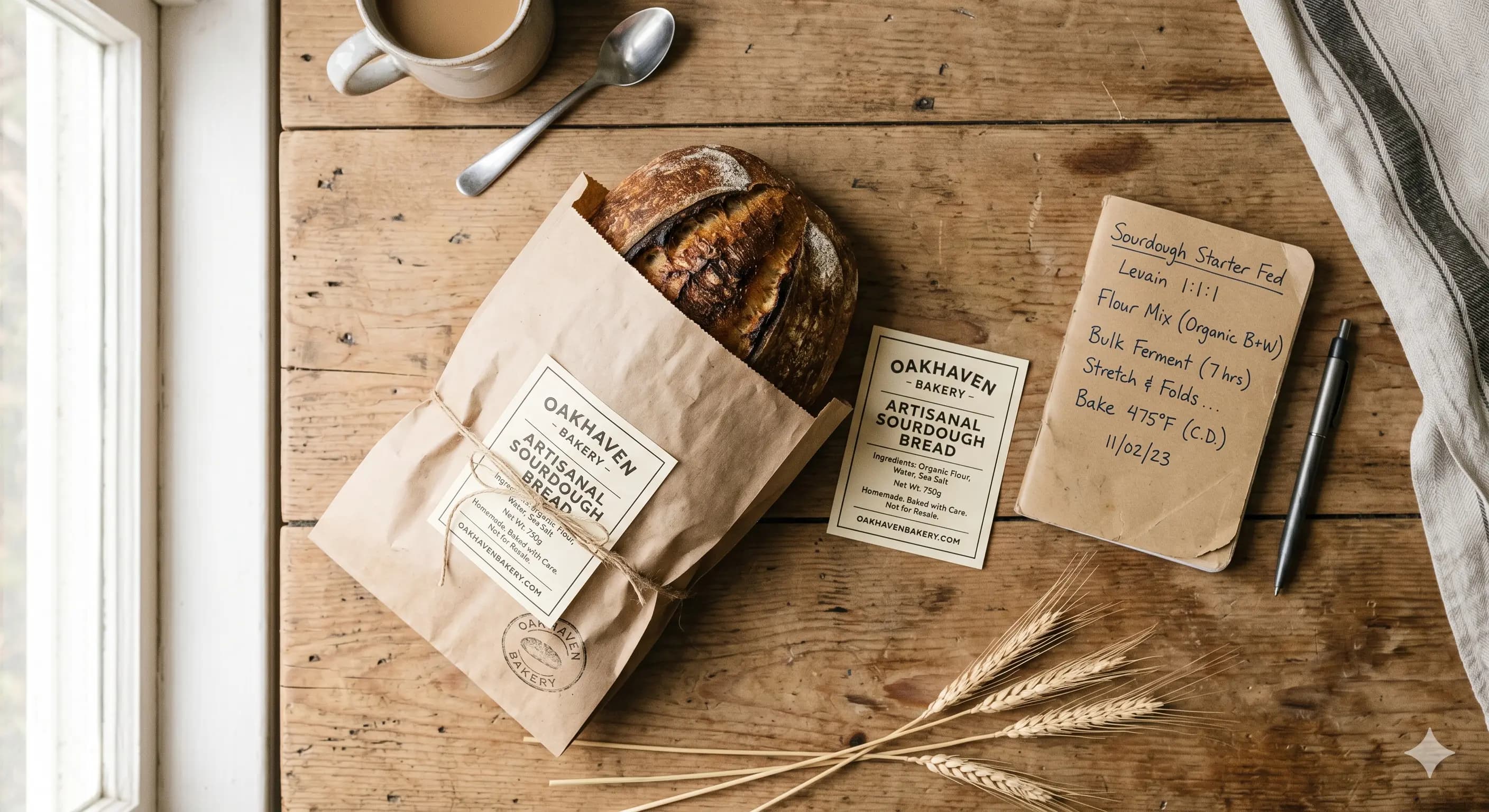
Most cottage food labeling guides will give you a list of required elements and call it done. This one goes further, because the list is actually the easy part.
Getting a label right on the first product you launch takes an afternoon. Keeping every label accurate six months later — after you switched chocolate chip brands, tweaked the brownie recipe, and your state quietly updated its required disclaimer wording — is the harder problem. Most guides never acknowledge it exists.
This guide covers both: the full cottage food labeling requirements and how to keep every label honest over time. It is written for home bakers running a weekly bread drop or Saturday porch pickup, not for commercial kitchens or farmers market vendors whose operations work differently. If you are newer to selling from home and are still confirming the legal foundation, the cottage food law explainer covers what is permitted in your state before you get to the labeling details.
By the end you will know every required element, where your state is likely to add its own rules, and what experienced bakers get wrong that first-timers never do.
Cottage food laws change, and label requirements vary by state. This guide covers elements that appear across most state programs. Always confirm your specific requirements with your state agriculture department before printing.
What Goes On a Cottage Food Label?
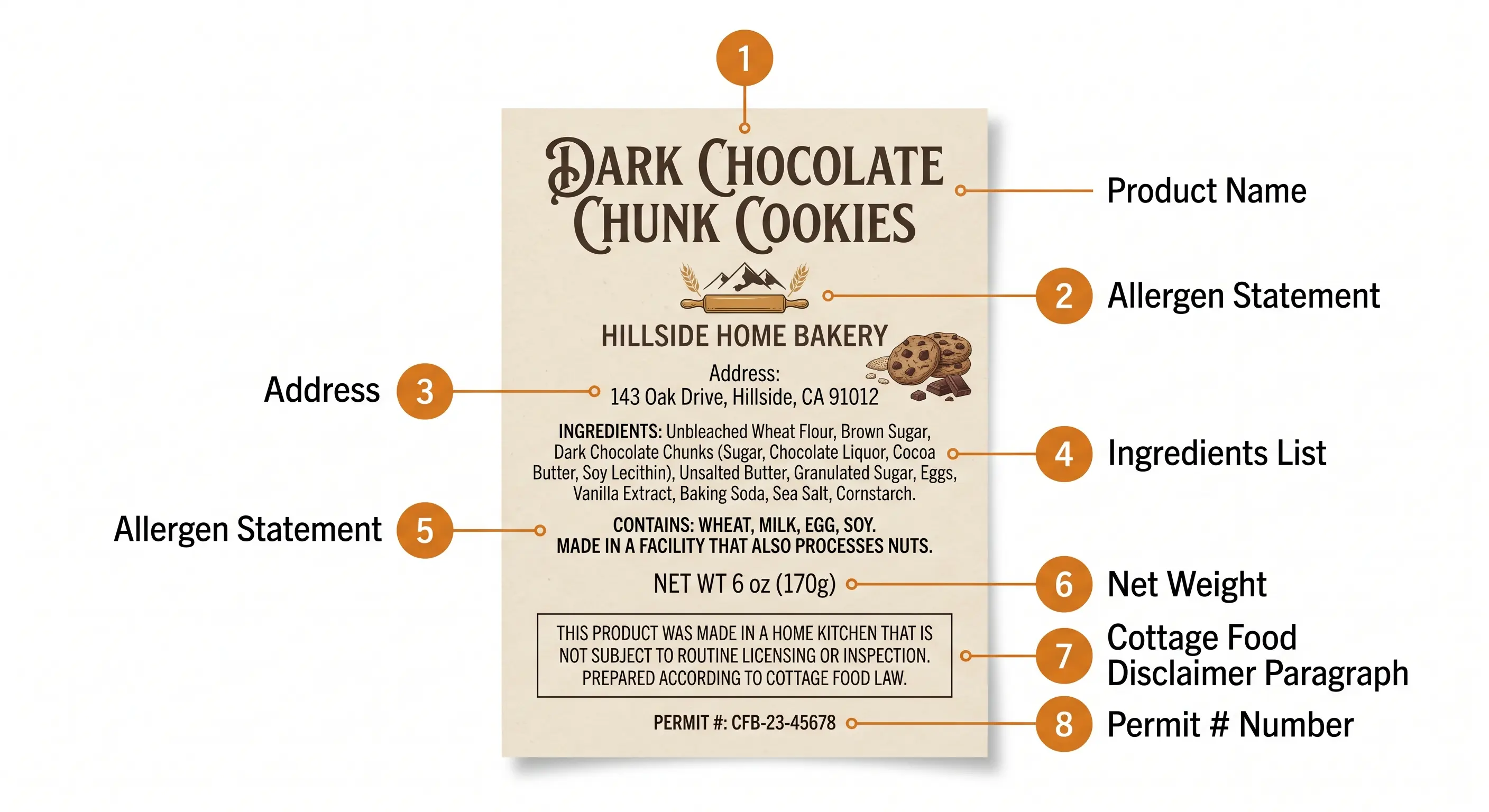
Most cottage food labels need to include eight core elements. This list is the answer to the question — save it and use it as a starting point every time you create a label for a new product.
- Product name — A clear, common name the customer understands without asking a follow-up question.
- Business or baker name — The name of the person or business that made the product.
- Address or location information — The required format depends on your state: full street address, city and state, or a permit number in some cases.
- Ingredients — Listed in descending order by weight. Every ingredient, including sub-ingredients from any packaged items you used in the recipe.
- Major food allergens — The nine federally recognized allergens, typically in a "Contains:" statement after the ingredient list.
- Net weight or quantity — How much product is in the package, expressed as weight for most packaged goods and as count for individually sold items.
- Required cottage food disclaimer — Exact language required by your state explaining the product was made in a home kitchen not subject to state inspection.
- Permit or registration number — Required in some states, optional or not applicable in others.
Some states add a ninth required element: a production or batch date. Texas is the most prominent example, and more on that below.
Why Each Element Matters
Product Name
Use the name a customer would recognize without context. "Dark chocolate chunk cookies" is correct. "Saturday box" or "batch A" is not. Your regulars know what you bake, but the name on the label needs to be useful to someone who has not ordered from you before, or to anyone reading it after the fact.
If your product has a meaningful variation — gluten-free, vegan, a seasonal flavor — include it in the product name so customers can identify what they ordered and what they are eating.
One note on claims: stick to descriptive names, not health or quality claims that require regulatory backing. "Whole wheat sourdough" is accurate. "Artisan whole wheat sourdough" is acceptable. "Cholesterol-lowering sourdough" is not something you can put on a cottage food label.
Ingredients
This element takes the most time to get right and the most ongoing effort to keep right. It is also the one most directly tied to allergen safety.
Ingredients are listed in descending order by weight — the ingredient present in the largest amount goes first. For a simple sourdough loaf, a basic ingredient list might read:
Ingredients: whole wheat flour, water, sourdough starter (whole wheat flour, water), sea salt.
Notice the parenthetical. If you use a sub-ingredient — a sourdough starter with its own components, a commercial spice blend, a flavored extract, a packaged mix — the sub-ingredients are listed inside parentheses immediately after the ingredient that contains them.
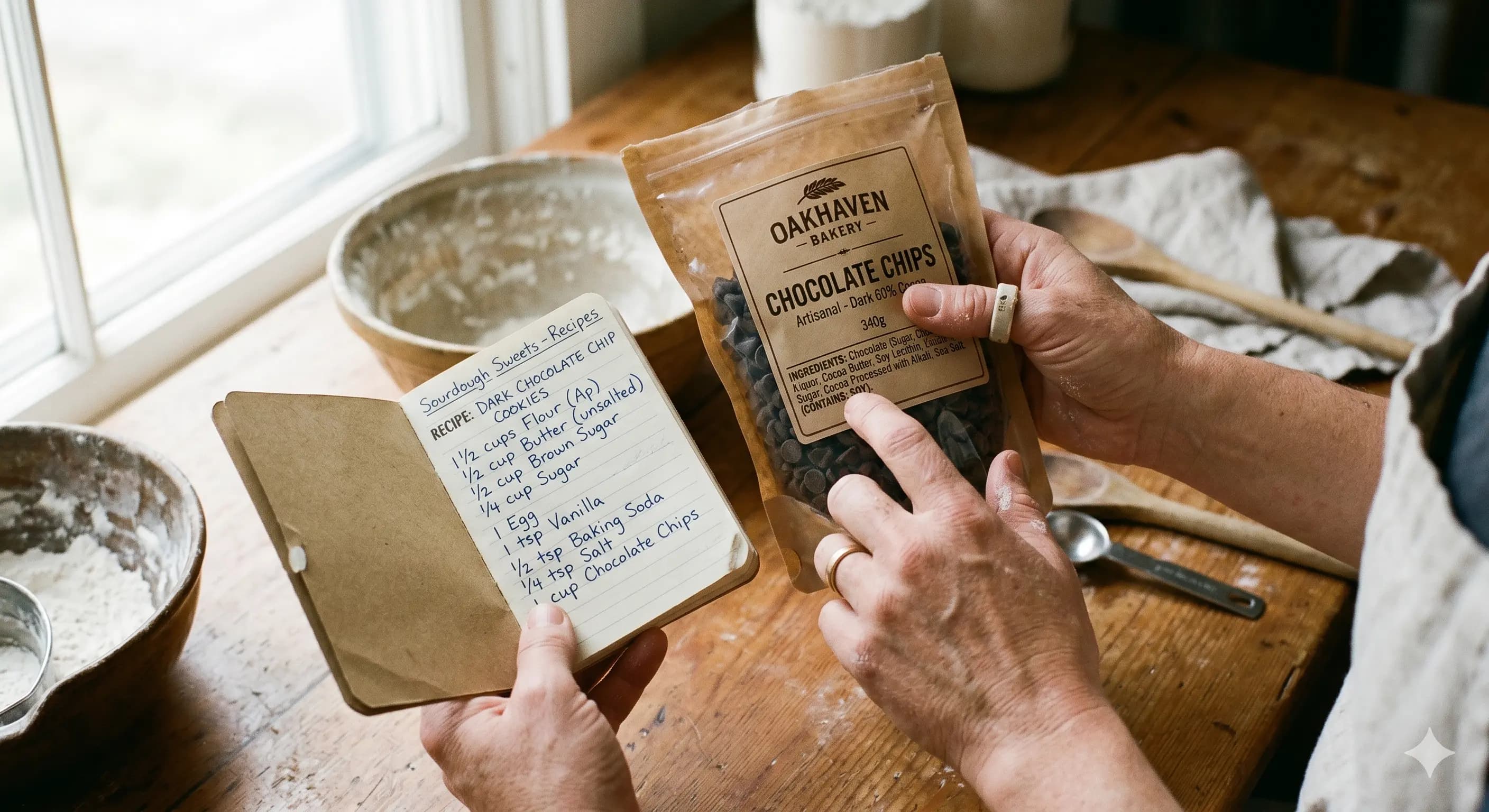
Where bakers get this wrong most often is with packaged ingredients they treat as single-item inputs. If you use a bag of chocolate chips, the ingredients on your label are not "chocolate chips." They are whatever the bag says: sugar, chocolate liquor, cocoa butter, milkfat, soy lecithin, vanilla. Copy those directly from the package. Do not summarize them.
This matters because your ingredient list is the foundation of your allergen statement, and an incomplete ingredient list produces an incomplete allergen statement.
Major Food Allergens
As of January 1, 2023, federal law recognizes nine major food allergens: milk, eggs, fish, crustacean shellfish, tree nuts, peanuts, wheat, soybeans, and sesame.
Sesame was added by the FASTER Act and became effective January 1, 2023. Many label templates and labeling guides published before 2023 list eight allergens and do not include sesame. If you are using an older template, check that sesame is on it.
Most cottage food bakers include allergens in a short statement immediately after the ingredient list:
Contains: wheat, milk, eggs, soy.
If your product does not contain a major allergen but you bake in a kitchen where that allergen is regularly present, check whether your state requires cross-contact language. Some states do. Many do not. Even where it is not required, noting "Made in a kitchen that also processes tree nuts" builds trust with your regulars who manage food allergies — and it is the kind of honest detail that earns you referrals from that community.
Net Weight or Quantity
For packaged items sold by weight — a loaf of bread, a bag of granola, a tin of brittle — use net weight. The standard is to list both ounces (oz) and grams (g). Cottage food programs are often less strict than commercial labeling rules about the exact format, but using both units is a safe default and looks professional.
For individually sold items — a single cookie, a scone, a jar of jam — count or volume is usually cleaner and more meaningful than weight. "6 chocolate chip cookies" or "1 cinnamon scone" tells the customer more than a gram measurement when they are holding the item in hand.
Business Name and Address
Every state requires some form of maker identification on the label. What varies is how much address information is required, and what format is acceptable.
- Full street address: Some states require this on every label.
- City and state only: Many states accept this as sufficient.
- Permit or registration number: Some states allow the permit number to fulfill part or all of the address requirement.
This is worth looking up specifically for your state before printing. A full home address on every label is workable — but if you operate out of a personal residence and have privacy concerns, check whether your state allows an alternative before committing to a label design.
Cottage Food Disclaimer
This is where the most compliance errors happen among home bakers, and nearly all of them are preventable.
Most states require language on the label explaining that the product was made in a home kitchen that has not been inspected by the state. The exact wording is usually prescribed — the law tells you what to say, not just what the statement should accomplish.
The critical rule: do not copy disclaimer wording from a label template, another baker's Instagram photo, or a blog post. Copy it from your state's official source. Your state agriculture department website or the text of the cottage food law itself is the right place. Forrager.com (forrager.com) is a well-maintained independent resource that links to official sources for each state's cottage food law.
Why does this matter so much? Because disclaimer wording changes when legislatures update cottage food laws, and templates do not update with them. Texas is a clear example: SB 541, which took effect September 1, 2025, updated the required disclaimer language for Texas cottage food operations. Bakers using older template language were technically out of compliance the day the new law took effect, even if their actual operation was completely lawful.
Copy the exact language from the official source. Do not paraphrase. Do not shorten it.
“Copy the exact language from your state's official source. Do not paraphrase. Do not shorten it. Bakers using outdated template wording were technically out of compliance the day the law changed — even if their operation was completely lawful.”
Permit or Registration Number
Not every state requires a permit or registration to operate under a cottage food law, but many do — and if your state requires registration, the number typically belongs on every label.
California is one of the clearest examples. The California Homemade Food Act requires registered cottage food operators to include their registration number on every label they print. The registration process and the labeling requirement are connected: completing one without the other leaves you incomplete on both fronts.
If you are not sure whether your state requires registration, the same state agriculture department page or Forrager.com entry that has your disclaimer wording will typically answer this question too.
Production or Batch Date
Texas requires a production date on every cottage food label — the date the food was made, not the order date or the pickup date. If you bake a batch of sourdough on a Thursday for Saturday pickup, Thursday's date goes on the label.
Several other states have similar requirements. For bakers in states that do not require a production date, adding one anyway is a good operational practice: it ties the label to a specific batch, makes troubleshooting easier if a customer has a question, and creates a paper trail you may want later.
How State Requirements Differ
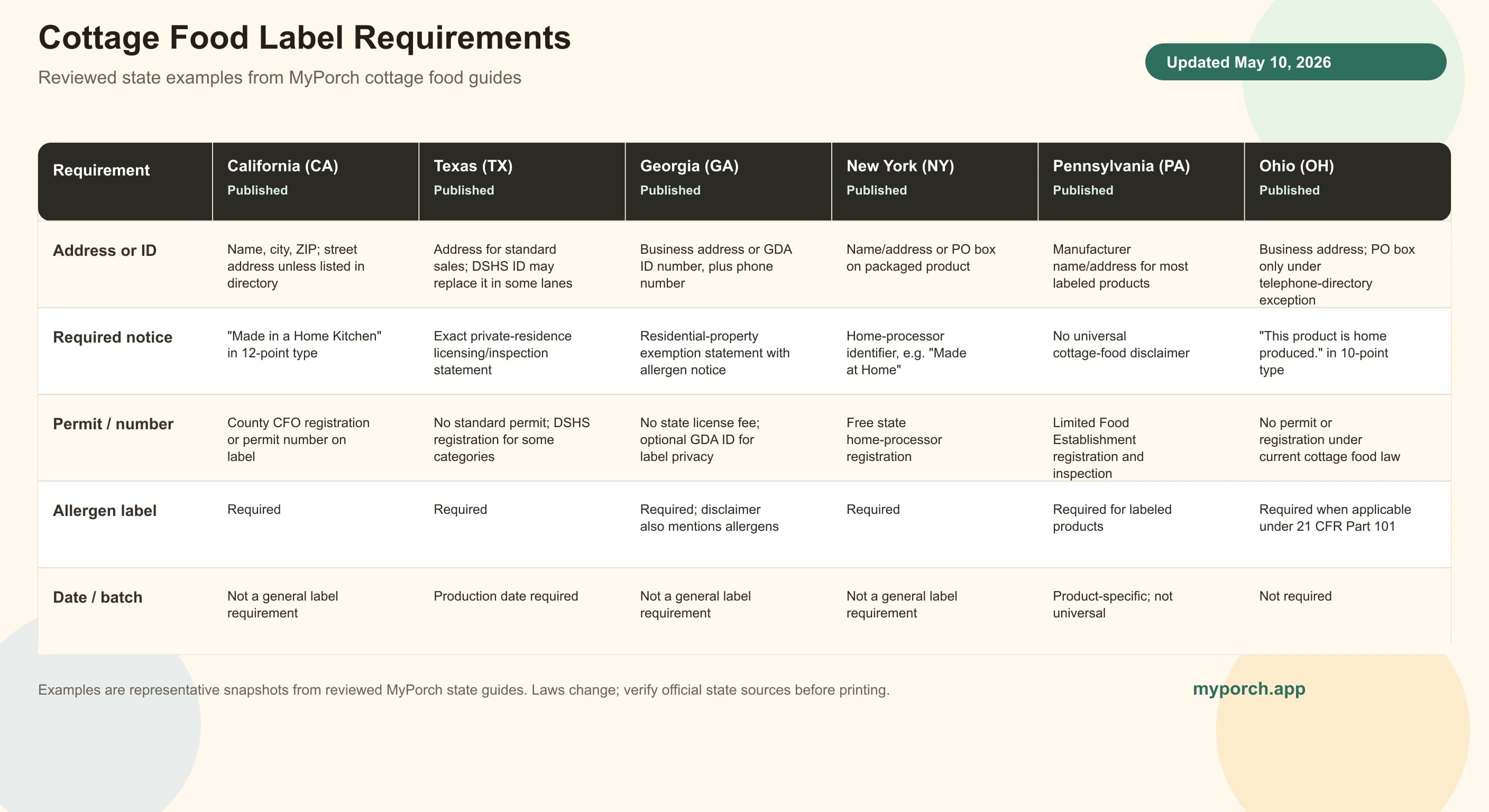
Most cottage food labels share the same core elements across all 50 states. The variation concentrates in four areas:
Address format — Full street address, city and state only, or an alternative tied to a permit number. Confirm which format your state requires before designing your label.
Disclaimer wording — States prescribe exact language or define specific topics the statement must address. The wording is not interchangeable between states, and it changes when laws are updated.
Permit or registration number — Required on labels in some states, irrelevant in others. California, for example, requires it on every label. Other states have no registration requirement at all.
Production or batch date — Required in Texas and in several other state programs. A good practice regardless.
The safest source for your state's current requirements is your state agriculture department. Forrager.com is a reliable secondary reference that links to official sources for each state and summarizes key points including sales limits, labeling, and permit requirements.
The Label Drift Problem
Here is the labeling mistake that experienced bakers make — not first-timers, but bakers who have been doing this long enough to have a regular Saturday crowd.
You create a label when you launch a product. It is accurate. You print 50 and put them in a drawer. Over the next two months:
- You switch from one brand of chocolate chips to another because the new bag was on sale. The new brand contains soy. The original did not.
- You start adding a quarter teaspoon of espresso powder to your brownie batter after your regulars said the first batch was a little flat. The espresso powder has its own ingredient list that includes tree nuts processed in the same facility.
- Your state updates its required disclaimer wording when a new cottage food bill passes.
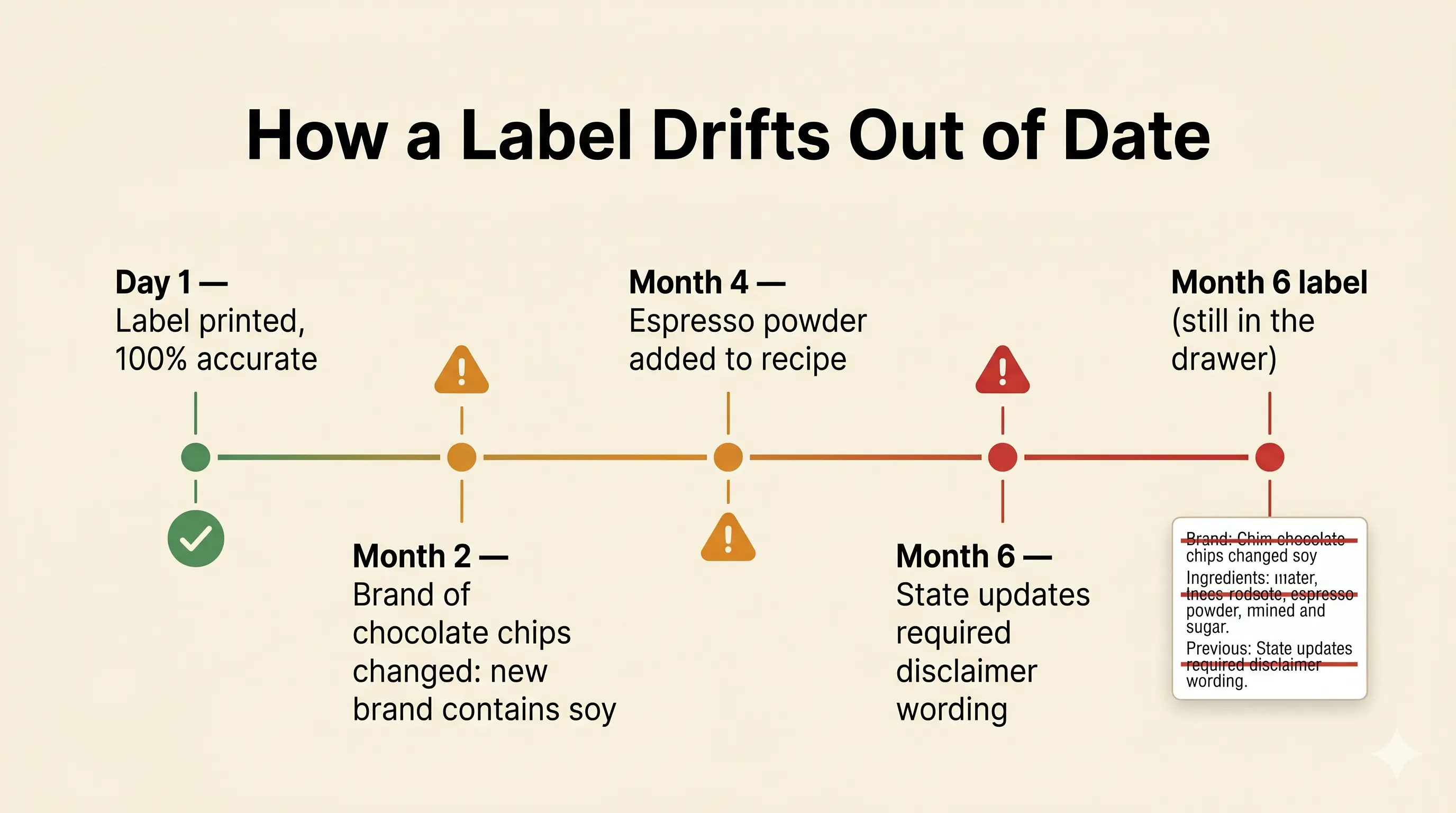
The label in the drawer now says the wrong things. If you are printing labels as you need them, you might catch these changes. If you printed 50 and you are still working through the stack, you probably will not.
This is the Label Drift Problem.
“The risk is not malicious — no baker is intentionally mislabeling. The risk is operational: labels and recipes are maintained separately, and they fall out of sync when either one changes without a trigger to review the other.”
The version of drift that creates the most real compliance risk is allergen drift: an ingredient change introduces a major allergen — or removes one — and the label does not reflect it.
The version of drift that creates the most real compliance risk is allergen drift: an ingredient change introduces a major allergen — or removes one — and the label does not reflect it. A customer with a soy allergy who relied on your "Contains: wheat, milk, eggs" label buys the batch made with the new chocolate chips. That is a serious problem.
Reducing Label Drift
Three practices catch most drift before it becomes a problem:
Treat the ingredient list as a living document tied to your recipe. When a recipe changes — even a small change like a different brand or a new sub-ingredient — update the ingredient list that same day. Not at the next print run. The same day.
Set a batch-based review trigger. Before printing labels for any new batch, spend five minutes comparing the label to the current recipe. Not once a quarter. Every batch. This is short enough to do every time and specific enough to catch changes while they are still fresh.
Keep a copy of the label used for each batch. If a customer asks about a specific order six weeks later, you want to know exactly what the label said for that batch — not what your current label says.
Before You Print: Final Review
Before you print labels for a batch, check these in order:
- Compare the ingredient list on the label to the recipe you are making for this specific batch. Are they identical?
- Check that every major allergen present in the current recipe is in the "Contains:" statement.
- Confirm the cottage food disclaimer is the current version from your state's official source — not a cached version from six months ago.
- Verify address, permit number, and production date requirements for your state are met.
- Check spelling, net weight, and quantity.
- If anything has changed since the last batch — any ingredient, any packaging, any state law update — update the label before printing a single sheet.
If you are setting up a product label from scratch rather than reviewing an existing one, the Cottage Food Label Checklist walks through each element step by step with examples.
Labeling as Part of the Order Workflow
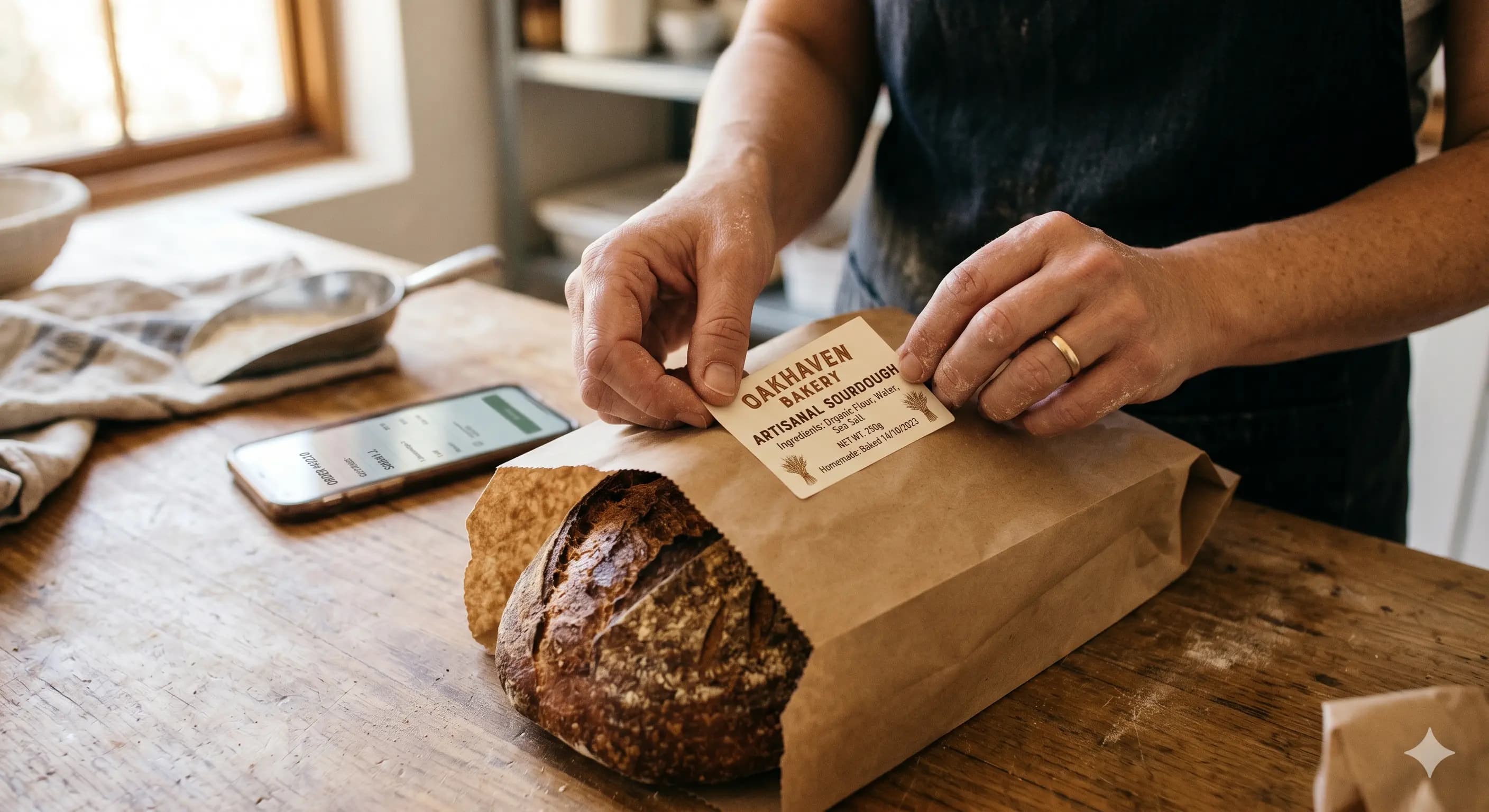
Most bakers treat labeling as a separate task from order management: create product → take orders → bake → print labels → attach → fulfill. That separation is where the Label Drift Problem lives.
When a label is disconnected from the order record, there is no reliable trigger that fires when an ingredient changes or when a disclaimer is updated. The label and the product operate independently until something goes wrong.
The more reliable approach is to connect them. When your product record holds the ingredients and allergens, and a label snapshot is created at the moment an order is paid, a few things become possible that are not possible when they are separate:
- The label for each paid order reflects what was in the product at the time of payment, not what is in the product today.
- If you update an ingredient next week, future order labels update automatically. Past order labels stay frozen.
- If a customer asks about an order from three Saturdays ago, you have a record of exactly what was on that label.
This is the model MyPorch uses. Product records carry ingredients, allergens, net weight, and permit details. The state-required disclaimer is generated automatically based on your bakery's registered state. When a customer pays, a label snapshot is frozen for that order — capturing what was true at the point of sale, independently of any changes made afterward.
For a baker running a weekly bread drop, this means labeling is part of the workflow, not a separate task that has to stay synchronized manually. The compliance record for each order exists because the order exists.
Frequently Asked Questions
Do I need a label on every cottage food item I sell?
Yes, in virtually every state with a cottage food law. The specific requirements differ — some states require labels physically attached to the package, others allow accompanying printed sheets in certain formats — but the baseline is that every packaged item you sell must be labeled. Unlabeled sales are the most straightforward way to run into compliance problems, even if your product itself is completely within the law.
What are the nine major food allergens that must be disclosed?
As of January 1, 2023, the FDA recognizes nine: milk, eggs, fish, crustacean shellfish, tree nuts, peanuts, wheat, soybeans, and sesame. Sesame was added by the FASTER Act and became effective in 2023. Any label template or guide that lists only eight allergens predates this change — update your labels to include sesame if you have not already.
What is a cottage food disclaimer and where do I find the exact wording?
A cottage food disclaimer is a required statement explaining that the product was made in a home kitchen not inspected by the state. The exact wording is set by your state's cottage food law, and it must be reproduced exactly — not summarized or paraphrased. Get the current wording from your state agriculture department's website or from the text of your state's cottage food law. Forrager.com links to official sources for each state's law and is a reliable starting point.
Does my full home address have to appear on the label?
Your state determines the exact format — options range from full street address to city-and-state only, with some states allowing a permit or registration number to fulfill part of the address requirement. Check your state agriculture department before finalizing your label design, especially if you are operating from a personal residence and have concerns about a home address appearing on every bag you hand to customers at a Saturday pickup.
How often should I review my labels?
Every batch. A five-minute comparison of the current label against the recipe you are making for that specific batch is more reliable than monthly or quarterly review schedules. Recipe changes happen between batches. Ingredient brand switches happen between batches. Catching those changes before you print is easier than discovering them after a label stack has been in circulation for a month.