You are standing at the trunk of your car in a rapidly emptying parking lot. The farmers market closed twenty minutes ago. You are tired, your feet hurt, and you are currently loading four unsold, perfectly baked country sourdough loaves back into your vehicle.
You baked 20 loaves for today. You sold 16. At $12 a loaf, you made $192. You spent $58 on ingredients and about eight hours of active and passive time over the last two days prepping, baking, and bagging.
Before you factor in those four unsold loaves, the math looks fine. But as you set the box in your trunk, the reality sets in: you spent money and time producing a product that is now effectively worthless. You are either going to eat it, give it to a neighbor for free, or throw it in the compost bin. By the time you drive home, your hourly rate for the weekend has dropped drastically.
This is not bad luck. It is not because your bread is not good enough. It is the inevitable result of a structural flaw in how you are running your business.
The speculative model — baking first, hoping to sell second — is the root of this financial leak. This is the bake to sell approach, and it costs more than most bakers realize. The bake to order model fixes it at the root.
Bake to Order vs. Bake to Sell: Two Ways to Run a Bakery
There are two fundamental approaches to home baking as a business, and the difference between them is not about skill, marketing, or pricing. It is about when payment is collected relative to when baking begins.
The speculative model (bake-to-sell): You decide what and how many to make, bake them, then try to sell. The risk of unsold product lives entirely with you. You end bake day — or farmers market day — loading boxes back into your car. The problem is visible: you can count the unsold loaves.
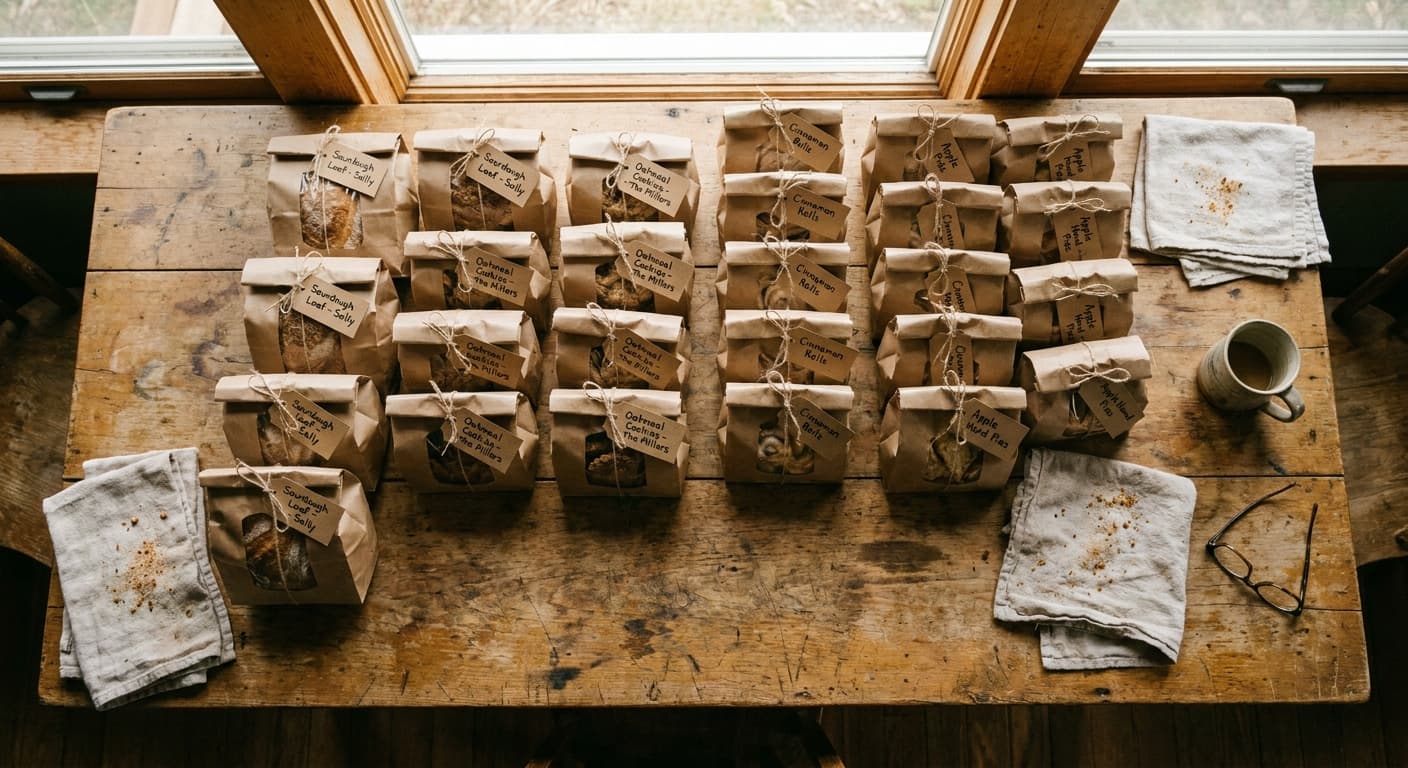
The batch order model (bake-to-order): You open a menu for a specific pickup date with a hard cutoff. Customers order and pay in advance. You bake exactly what was ordered in a single planned production run. The sale happens before the flour is even weighed. Zero unsold product. Zero financial risk from a slow week. This is the model most porch-pickup microbakeries run.
_Note: there is a third model common in baker Facebook communities — the 48-hour custom order ("DM me to order, I bake within 48 hours"). This model solves the waste problem but creates a different structural trap around economies of scale and schedule ownership. We cover it fully in Why Custom Orders Are Keeping Your Home Bakery Stuck._
Everything downstream — the uncertainty, the unsold boxes, the end-of-day discounts — is a consequence of which model you are running.
The Real Cost of Unsold Product
Every unsold unit is not just a missed opportunity. It is a physical item you paid to make, paid to package, and spent hours of your life on, with absolutely nothing to show for it. When you bake speculatively, you build a hidden tax into your business by design. It does not feel like a decision. It just feels like a bad day.
Take a home baker who bakes 20 loaves of sourdough a week at $12 each. A 15% unsold rate — 3 loaves going home per week — is better than most farmers market days.
- Weekly waste: 3 loaves × $12 = $36
- Monthly waste: $36 × 4 weeks = $144
- Annual waste: $36 × 48 bake weeks = $1,728
On $12,240 in gross revenue, that is 14% of her top line going straight to the compost bin — not lost sales, but cash she actively spent that should have been profit.
The difference is not the baker's skill at selling. It is which model absorbs the risk of a slow week.
Now run the same math under a batch model. She opens orders Wednesday night, closes them Thursday at 9pm, and bakes exactly what was ordered Saturday morning. If she gets 17 orders, she bakes 17. If she gets 20, she bakes 20. If she gets 12, she bakes 12 — and she knew that on Thursday, giving her time to adjust her prep.
Unsold units: zero. Waste rate: zero. That $1,728 stays in the business.

How the Batch Model Works
The mechanics are simple. The discipline is the hard part.
- Set your menu and your maximum. Decide what you are offering and the most you can produce of each item. Once an item sells out, it is gone.
- Open orders. Post your menu with a clear cutoff date and time. Collect payment at the time of order — not at pickup.
- Close orders at the cutoff. No exceptions. Wednesday at 9pm means Wednesday at 9pm, not Thursday morning for the customer who "just forgot."
- Generate your production list. What was ordered is what you make. Nothing else.
- Buy exactly what you need. With a confirmed order list, ingredient purchasing becomes math, not guessing.
- Bake, pack, and fulfill. Bake day is logistics. Every item has a name on it before you start.
The entire model depends on step three. Bakers who let the cutoff slide end up managing last-minute changes, buying extra ingredients the morning of, and baking in reactive panic instead of a planned sequence. The cutoff is not a customer service policy — it is the mechanism that makes everything else predictable.
The Cutoff: Why One Rule Changes Everything
A hard order cutoff does more than protect the baker's schedule. It reshapes how customers think about ordering.
When the menu closes at a fixed time, customers learn to order when the menu opens — not when they get around to it. "Orders close Wednesday at 9pm" is a deadline that creates urgency. Bakers consistently report that switching from a loose "order whenever" model to a firm cutoff _increases_ their order volume, because customers who know the window is closing act faster than customers who assume there is always time.
The cutoff also communicates something valuable about the product: it is made in limited quantities, by one person, on a specific schedule, to order. That is the opposite of a grocery store. It is exactly the reason customers pay $12 for a loaf they could buy for $4 down the street.
Real language you can use with your audience: _"Hey everyone! To ensure I have enough time to properly ferment your dough and source the best ingredients, all orders for this weekend's drop must be placed by Wednesday at 9pm. The storefront will automatically lock at that time — grab your loaves early!"_
Three proven cutoff structures:
- The weekend drop: Menu posts Sunday. Orders open Monday. Cutoff Wednesday 9pm. Pickup Saturday morning.
- The midweek drop: Menu posts Thursday. Orders open Friday. Cutoff Sunday 9pm. Pickup Wednesday evening.
- The holiday mega-drop: Used for Thanksgiving pies, holiday cookie boxes, and seasonal items. Announce 2–3 weeks out. Cutoff 7 days before pickup. Pre-orders only — no walk-up units.

"My Customers Won't Pre-Order"
This is the most common reason bakers give for staying with the speculative model. It is worth taking seriously — and then dismantling.
Your customers pre-order their dinner reservations on OpenTable. They pre-order their morning latte on the Starbucks Mobile app. They subscribe to weekly CSA vegetable boxes. They are not resistant to pre-ordering — they are resistant to complicated pre-ordering.
The actual failure mode is not customer unwillingness — it is a friction-filled ordering process. If ordering requires DMing you, waiting for a reply, Venmoing you separately, and then texting again to confirm a pickup time, some customers will not bother. Not because the bread is not worth it, but because the process feels uncertain.
A simple online menu with a clear order button, upfront payment, and an automatic confirmation removes every source of friction. When the process is that easy, most customers prefer pre-ordering — it guarantees they get their loaf on Saturday instead of arriving at the market to find it sold out. For the mechanics of setting that system up, see How to Take Pre-Orders for Your Home Bakery.
The few customers who genuinely will not pre-order are usually the ones who also add last-minute items, ask for exceptions to your cutoff, and cause a disproportionate amount of bake-day stress. The batch model naturally filters them out, which turns out to be a feature.
What Else Changes When You Switch
The end of speculative waste is the most visible benefit, but several other things improve at the same time.
No more end-of-day discounting. "Two for $10" to move product at 4pm trains customers to wait for markdowns and erodes the perceived value of your product. When there are no leftovers, there are no markdowns.
Ingredient purchasing becomes exact. After your cutoff closes, your bake list tells you exactly how much flour, butter, and every inclusion you need. You stop buying ingredients "just in case" and start buying exactly what you need — drastically reducing overhead and pantry waste.
Bake day becomes a fulfillment operation. You are not making decisions on Saturday morning about quantities, flavors, or allocations. Those decisions were made when orders closed. Bake day is now execution, not problem-solving.
Your hourly rate becomes calculable. One of the most disorienting things about the speculative model is that you do not know what you earned until the day is over. In the batch model, you know your revenue before you preheat the oven. That clarity — knowing the answer before you start — is one of the most underrated improvements in the whole switch.
Customer relationships improve. Pre-order customers are highly invested regulars who respect your time. They told you what they wanted, paid in advance, and are coming specifically to collect their order. That is a different quality of relationship than a market browser who might buy something or might not.
The Bridge: From Model to System
The batch model is a philosophy. To run it in practice, you need a system that handles four things: a menu that opens and closes, upfront payment collection, order tracking, and a production list that comes out of the orders.
The manual option is to stitch together a Google Form, Venmo requests, and a spreadsheet. It works okay for the first few weeks — right around the 15-order mark, the system breaks. You miss a Venmo notification, double-book a pickup time, or lose an order entirely.
MyPorch is built specifically to run this workflow. You set your menu, open orders, and the system handles payment collection, order confirmation, and bake list generation automatically. When your cutoff hits, MyPorch closes the storefront — preventing late additions — and generates a clean production list organized by product with customer names attached, before you touch your starter.
The batch model is worth running even with a manual system. It is significantly easier to run with a purpose-built one.
Start your free MyPorch storefront →
Already filling custom orders to avoid waste but still feel like you're constantly scrambling? That is a different problem — and a more common one. Read: Why Custom Orders Are Keeping Your Home Bakery Stuck →