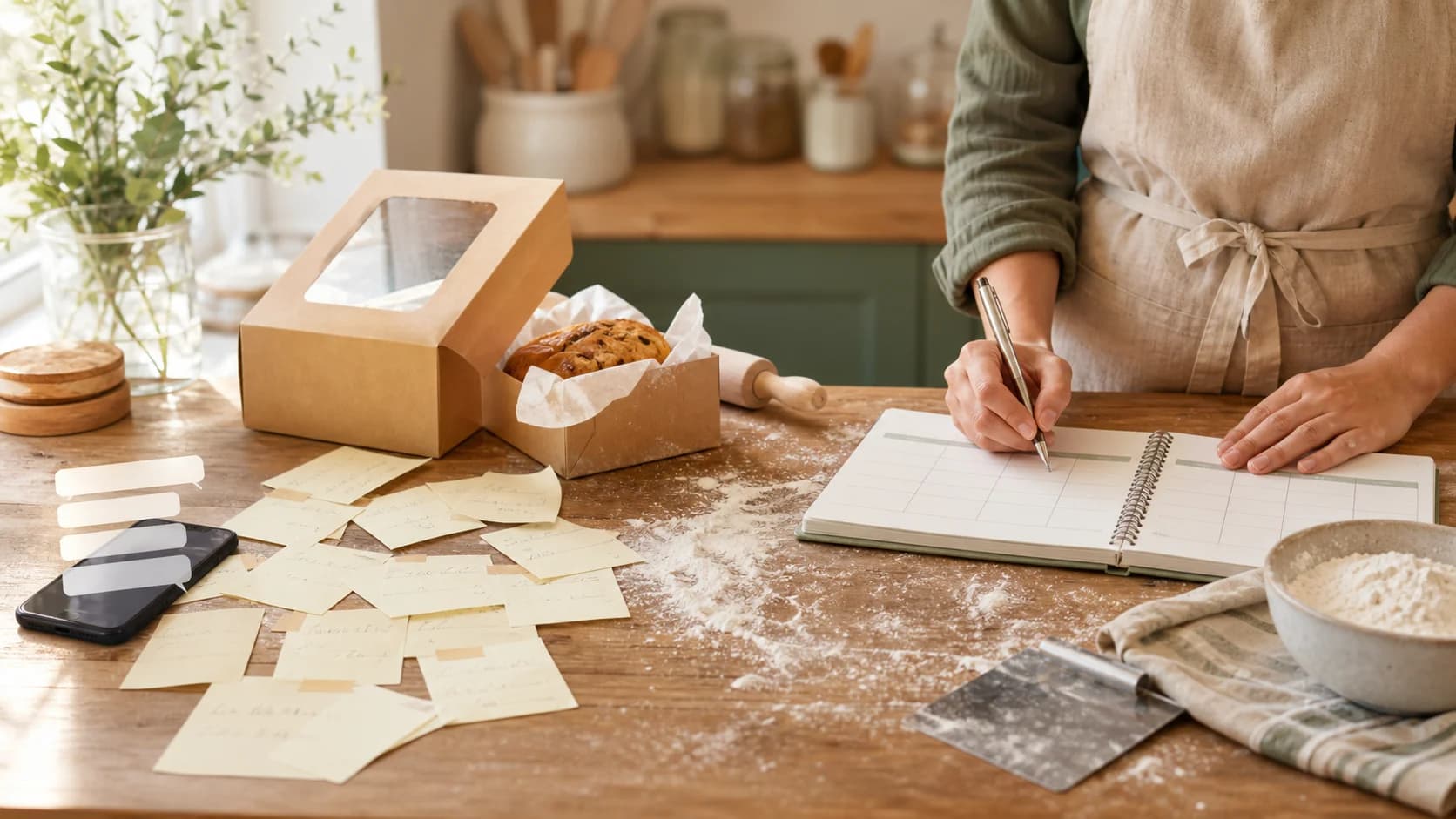
You started baking for friends first. Then someone posted about you in a neighborhood Facebook group, and the DMs started coming in. You set up a simple system: text you, give 48 hours, pay on pickup. No market booth to rent. No days off work. No upfront investment. Just baking what people ask for, when they ask for it.
It worked. It still works. And somehow, six months in, you are more tired than you expected to be — answering DMs at 9pm, buying flour on short notice, fitting bakes into gaps that keep shifting. You have thought about raising your prices. You have thought about getting more customers. You have not thought about the possibility that the model itself is the problem, because from the outside it looks like exactly what a home bakery is supposed to look like.
It is not. It is a ceiling with no visible ceiling. And the model driving it — custom orders for your home bakery — is the thing worth examining.
Why Custom Orders Look Right — And What They Actually Cost
There is nothing obviously wrong with the 48-hour custom order model. No wasted product. No booth rental fees. No committing to a schedule you do not know if you can keep. When the first few orders come in through DMs, it feels like the most sensible way to run a bakery out of your home.
And at low volume, it is. The problems are not visible at five orders a month. They surface somewhere around fifteen or twenty, when being busier starts to feel like more work without more payoff — when a day off starts to feel like a day you are declining potential orders, and the money still does not seem to be growing the way the effort is.
The on-demand model has two structural costs that only become visible as you try to grow. Neither one feels like a model problem. Both of them are.
The first cost is economies of scale. Every custom order you bake in isolation absorbs the full fixed overhead of a production run: the preheat time, the setup, the cleanup. When you bake one loaf, one loaf pays for all of it. When you bake twenty, it is spread across twenty. Running custom orders means effectively baking one loaf at a time — and charging yourself the full overhead cost of a production run on each one.
The second cost is schedule ownership. In the on-demand model, your schedule is not set by you — it is set by whenever your customers decide to text. You cannot block off a day in advance. You cannot commit to childcare or a trip or a day job shift without wondering if an order will come in. Every week is improvised. Improvised does not scale.
Neither of these feels like a "model problem" because neither of them shows up as a line item. They show up as exhaustion.
The Economics of Baking One Loaf at a Time
Here is the math that most on-demand bakers have never run.
Every bake day has fixed overhead: the time to preheat the oven, set up your workspace, and clean up after. Call it 90 minutes — a conservative number for a real bake day, not a quick cookie batch. That overhead exists whether you bake one item or twenty.
Consider two bakers selling sourdough at $12 a loaf. After ingredients, the gross profit per loaf is $9. The only difference between them is batch size.
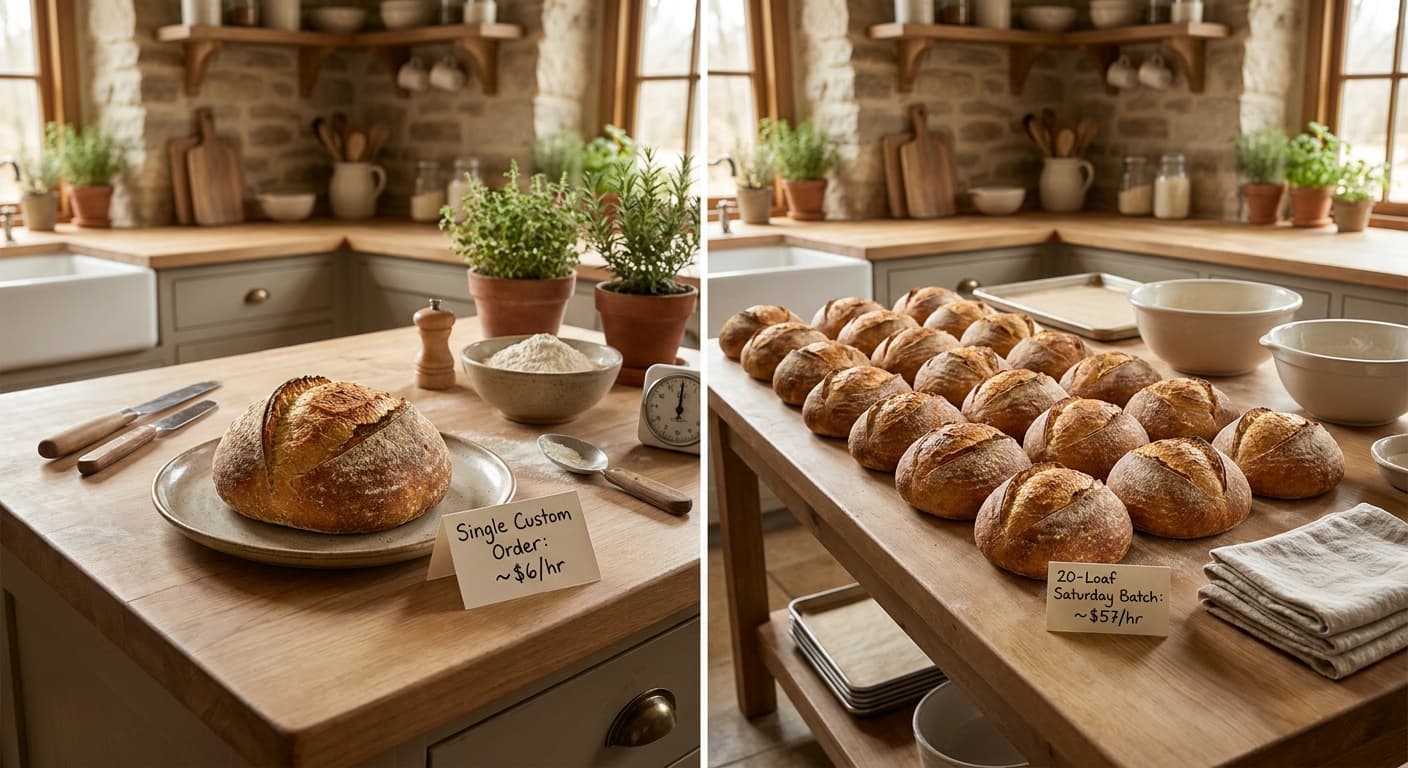
The custom-order baker — one loaf for a Tuesday DM request: - Fixed overhead time: 90 minutes - Active time per loaf: 5 minutes - Total time invested: 95 minutes - Gross profit: $9 - Effective hourly rate: ~$6/hr
The batch baker — 20 loaves for a Saturday pickup: - Fixed overhead time: 90 minutes - Active time (20 loaves × 5 min): 100 minutes - Total time invested: ~3 hours 10 minutes - Gross profit: $180 - Effective hourly rate: ~$57/hr
The product is identical. The price is identical. The ingredients are identical. The difference is entirely how many units absorb the fixed cost of the production run.
In the custom-order model, you are not running a bakery. You are running a kitchen as a short-order cook — paying full production overhead for every single order, one at a time.
You are not earning $6/hour because you are undercharging. You are earning $6/hour because the model forces 90 minutes of fixed overhead onto a single $12 sale. Raise the price to $18 and you earn $9/hour. The math does not fix itself with price increases. It fixes itself when more units share the cost. (For the full pricing formula — ingredients, packaging, labor, and margin — see the home bakery pricing guide.)
The gap between the exhausted custom-order baker and the profitable batch baker is not effort, pricing, or customer count. It is how many loaves share the overhead of a production run.
Your Schedule Is Not Yours
The second cost is harder to measure but easier to feel.
In the on-demand model, your schedule is a function of your customers' decision to text you. You might get three orders on a Tuesday and none on Wednesday and two more Thursday night. You never know when you will need to bake. You never know when you can stop.
Walk through what this means in practice:
- You cannot commit to a day off, because there is no structural reason to decline an order that comes in.
- You cannot plan a prep day, because you do not know what you will be prepping for until the orders arrive.
- You cannot coordinate childcare around bake day, because you do not know when bake day will be.
- You cannot buy ingredients in advance or in bulk, because you do not know what you will need until the next DM lands.
- You cannot bring in any help — a partner, a teenager, a friend — because there is no repeatable workflow to train them on.
Teaching someone to assist you would take longer than doing it yourself, because there is nothing consistent to teach. Every order has its own timing, its own pickup logistics, its own payment method. Every week is improvised from scratch.
Improvised does not scale. Reactive does not grow. The baker who cannot commit to a schedule cannot build on one.
The Ceiling You Cannot See
Most on-demand bakers who feel stuck attribute it to one of two things: they are not charging enough, or they do not have enough customers.
Both are usually partially true. But neither addresses the actual constraint.
The on-demand model has a ceiling built into it. It is not a pricing ceiling and it is not a customer ceiling — it is a structural ceiling. You can raise your prices and get more customers and still hit the same wall, because the thing that caps your growth is the model itself.
As you add more customers, you get busier but not proportionally more profitable. Your hourly rate does not improve meaningfully because your batch sizes are not growing — each order is still a standalone production run. You start to feel close to capacity when you are actually at a ceiling. The work is real. The exhaustion is real. The growth is not there because the model does not allow it.
If you interpret it as a pricing problem, you raise prices — and that helps at the margin. If you interpret it as a customer problem, you get more customers — and that mostly makes you busier. Neither fixes the underlying constraint.
The fix is not a number. It is a model change.
What the Batch Model Gives Back
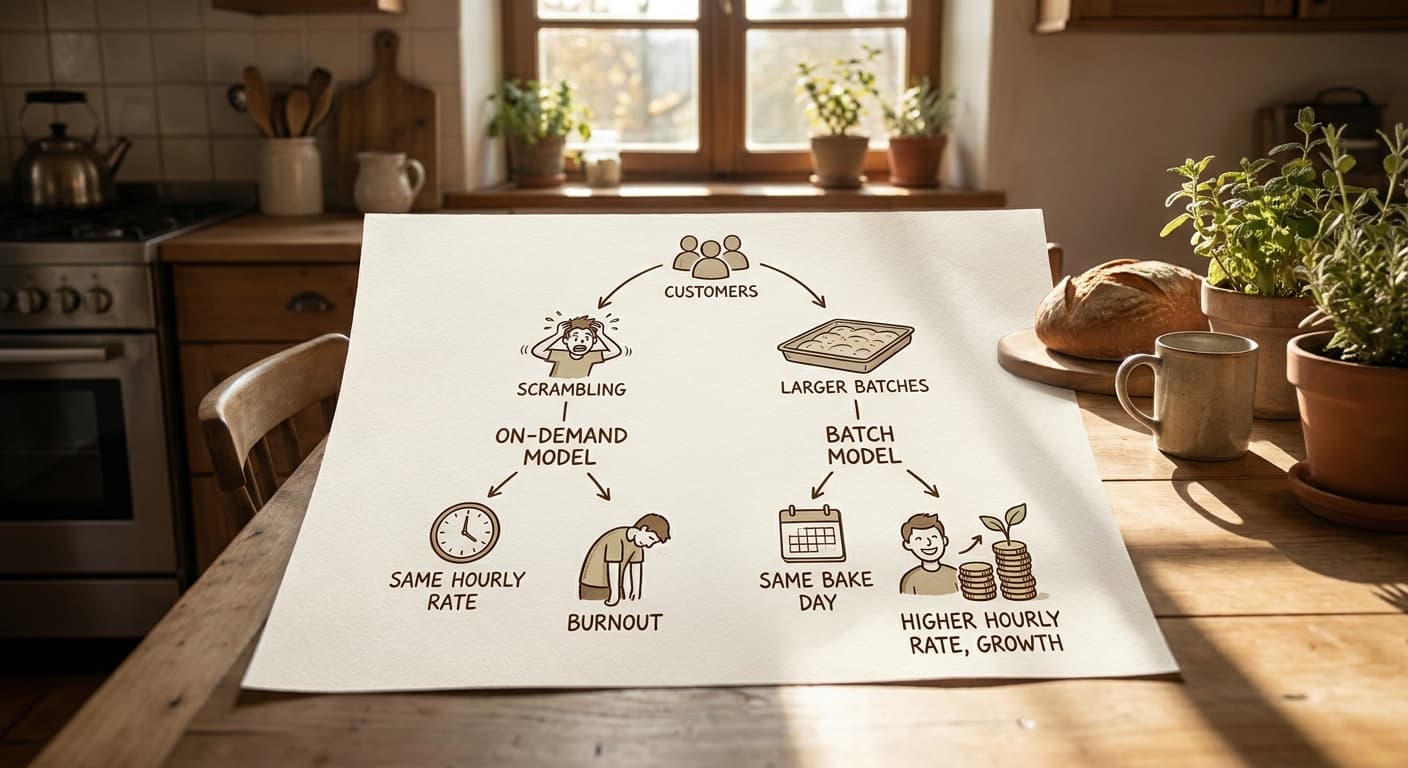
The batch order model does not require you to bake more. It requires you to bake differently.
Here is what one planned bake day per week looks like in practice:
A schedule you can protect. You open orders Monday, close them Wednesday at 9pm, and bake Saturday morning. Every week follows the same rhythm. You can block off Tuesday as a rest day, coordinate childcare around Saturday, and actually commit to plans in advance — because you know exactly when you will be baking.
Production runs that pay. Instead of one loaf absorbing 90 minutes of overhead, you bake 15 or 20 or 25 and spread that cost across the full batch. The hourly rate on a 20-loaf Saturday looks nothing like the hourly rate on a single-order Tuesday.
Ingredient purchasing that becomes arithmetic. After your cutoff closes Wednesday night, you know exactly what you need: how much flour, how much butter, how many inclusions. You stop buying perishable ingredients "just in case" at retail prices mid-week and start placing one deliberate order with exactly what the batch requires.
A workflow you can teach. Because Saturday bake day follows the same sequence every week — prep, mix, shape, bake, pack — you can bring in help. A partner can handle packing while you manage the oven. A teenager can label bags. You are not improvising; you are executing a plan. Plans can be delegated.
Revenue you know before you start. When your cutoff closes, your bake list is final and your revenue is locked. You know what you earned before you preheat the oven. That is the opposite of ending a bake day wondering if it was worth it.
The batch model does not give you more customers. It gives you a structure that lets more customers translate into more money and more time — rather than just more work.
The Transition: What Actually Changes
Switching from custom orders to a batch model does not require an announcement or a policy document. It requires one change: the next time someone asks you for a custom order, you say "I do pre-orders — here's my next menu" instead of "sure, give me 48 hours."
The mechanics are simple. Post your menu for the week with a cutoff date and a pickup time. Collect payment when the order is placed. Bake what was ordered on your scheduled bake day.
Most customers adapt immediately, especially once they understand that pre-ordering guarantees they get their item before it sells out — which is more than they had before. The few who push back on the schedule change are usually the same customers who added last-minute requests, asked for exceptions, and sent texts at 10pm. The batch model filters them out. That is a feature.
The customers you are worried about losing are your regulars. Here is the honest truth: some of them may leave, at least initially. The bakers who have made this switch consistently report that the customers who left were disproportionately the most demanding ones — the ones driving the most friction and the least profit. The ones who stayed, and the new customers who found them through a more discoverable storefront, were better fits.
You do not need to phase this in. You do not need to grandfather existing custom order customers on a special arrangement. You open your next menu with a cutoff, you communicate it clearly, and you hold it. The first week feels uncertain. The second week feels like a rhythm. By the fourth week, it is just how your bakery works.
From Model to System
The batch model is a philosophy. Running it consistently requires a system that handles four things: a menu with open and close dates, upfront payment collection, order tracking, and a production list generated from the orders.
The manual version — Google Form, Venmo, spreadsheet — works at low volume. Around 15 orders per batch it starts to break. You miss a payment notification, double-book a pickup window, or lose an order between the form and the spreadsheet. The more customers you have, the more the manual version costs you in attention and errors.
MyPorch is built specifically for this workflow. You set your menu, your inventory caps, and your cutoff — and the system handles payment collection, order confirmation, and production list generation automatically. When the cutoff hits, the storefront closes on its own, preventing late additions, and generates a clean bake list with customer names before you touch your starter.
Stop running your business like a short-order cook. You already solved the waste problem — it is time to solve the scale problem. The batch model is worth running even with a manual system. A purpose-built one makes it significantly easier to hold.
Set up your free MyPorch storefront →
Coming from speculative baking — making product first and hoping to sell it at a farmers market or roadside stand? That is a different problem with a different fix. Read: Bake to Order vs. Bake to Sell: Why Speculative Baking Is Costing You More Than You Think →